"With affection beaming in one eye, and calculation shining out of the other." - Charles Dickens

Wednesday, March 10, 2010

Brazil Succumbs to FAO and United Nations BrainWashing

Here we go again, another 'authority' claims that methane emissions by grazing animals makes up one-third of this planet's greenhouse gas emissions.  Our own EPA provides us a handy chart that makes the respected Dr. Alex Chaves of the University of Sidney look like a student rather than a member of the faculty.  Per the EPA, CH4, or methane, accounts for 14.3% of Global GHG emissions, and that includes other sources beyond cattle, like Coal production.

Dr. Chaves' answer to solving this exaggerated statement in regard to beef cattle methane emissions is.....drum roll please....feeding Australia and Brazil's livestock more by-products to make their belches and their dung more environmentally friendly.  He really caught me off-guard on that position, really, I would have never thought either Australia or Brazil would buy in to this FAO generated bunk of modifying the grass diet of grazing cattle...and Dr. Chaves actually has the temerity to claim his bio-diesel byproducts will improve the grazing cows nutrition.  Does he have a personal interest in bio-diesel byproducts?  Is he looking to patent a new bio-diesel feed?  What would be the motivation of Dr. Chaves?  What is the motivation of Al Gore?  Right answer.

Figure 1: Global Anthropogenic Greenhouse Gas Emissions in 2004
Figure 1: Global greenhouse gas emissions, 2000. This pie chart shows the breakdown of global greenhouse gas emissions by gas. CO2 emissions from fossil fuel combustion and cement manufacturing account for 55 percent of the total. CO2 emissions from land use change and forestry account for another 19 percent. Methane emissions account for 16 percent of the total, nitrous oxide accounts for 9 percent, and the high-global-warming-potential gases (such as sulfur hexafluoride) account for 1 percent.


Greener grazing to reduce greenhouse gas emissions

3 March 2010
Gases such as methane expelled by grazing animals make up roughly one-third of global greenhouse gas emissions.Dr Alex Chaves, Senior Lecturer of Animal Nutrition in the Faculty of Veterinary Science, is working on ways to reduce these livestock emissions, which contribute to global warming.
Working in collaboration with the CNPGL-EMBRAPA (Dairy Research Centre) and the Federal University of São João del-Rei in his native Brazil, Dr Chaves plans to supplement ruminant feed in Brazil and Australia with biodiesel by-products, such as press-oil seeds and glycerol.
"Brazil has a massive biodiesel industry," he explains. "By using biodiesel by-products in animal feeding, we can hopefully improve animal nutrition and performance, and reduce methane emissions per unit of production."
While Brazil has the second-largest number of livestock animals in the world (170 million head), the quality of its grasses is lower (tropical grasses, or "C4") than those in temperate areas (temperate grasses, or "C3"). This means its animals develop at a slower pace, and therefore emit more methane over their lifespan.
Essentially, Dr Chaves' project aims to improve the quality of Brazil's grasses from C4 to C3, to improve the performance and sustainability of the agricultural sector.
"The better the nutrition, the better the efficiency," he explains. "And the better the efficiency, the less animals you need to produce to feed human beings. This means lower emissions."
"We are trying to kill two birds with one stone," he continues. "We are trying to reduce methane emissions while simultaneously improving animal performance as well as the nutritional quality of the meat and milk."
If the project is as successful as Dr Chaves anticipates it will be, it will help producers to maximise livestock productivity, improve the income of thousands of farmers in marginal regions including outback Australia and lower greenhouse gas emissions, mitigating anthropogenic climate change.

Contact: Michelle Wood
Phone: 02 9351 3191
Email: michelle.wood@sydney.edu.au

Sunday, March 7, 2010

Bill Introduced to Prevent the EPA from assessing a "Cow Tax" - What Happened to this Bill?

 This anti "Cow Tax" bill, introduced right at a year ago, is sitting in the Committee on Environment and Public Works, per govtrack.us.  Their are 13 co-sponsors of the S.527 in the U.S. Senate, and Texas Representation is Sadly Missing.  Voice your support of this bill at WashingtonWatch.com.  The minority voice of Vegan Meat Haters would appear to be the vast 'majority' of any concerned US citizens who have taken the time to 'click' their opposition to this bill --take the time to voice your support, the risk to the family farm is quite real.

United States Senate Cosponsors:

Thune, Schumer Introduce "Cow Tax" Prevention Bill, Puts Nail In Coffin Of Inane Proposal That Could Cost SD Farmers An Estimated $367 Million And Put Family Farms At Risk Of Going Out Of Business


Financial Impact Would Be Devastating To The Thousands Of Family-Owned Farms in South Dakota
"March 5th, 2009 - Washington, D.C. - U.S. Senators John Thune and Charles E. Schumer (D-NY) today introduced a bill (S.527) that will once and for all prevent the government from imposing an onerous "cow tax" on farmers across the country. Late last year, the Environmental Protection Agency (EPA) discussed regulating greenhouse gases in its Advanced Notice of Proposed Rulemaking under the 1990 amendments to the Clean Air Act, which could include requiring farmers to purchase expensive permits. Although the EPA did not propose moving forward with the permits, Thune and Schumer are taking preventive action to protect America's farmers. The "tax" would cost South Dakota farmers an estimated $367 million -- or $175 per dairy cow, $87.50 per beef cow, and $20 per hog -- fees that could put already struggling family farms on the brink of closure.

In a move to alleviate farmers' fears and ensure that such a proposal is never implemented, Thune and Schumer introduced legislation to prevent the EPA or any other governmental agency from imposing this fee on farmers.

"The Clean Air Act was written to curb pollution from smokestack industries, not to regulate livestock production in South Dakota or elsewhere," said Thune. "Livestock producers do not need another burdensome regulation to worry about, and this legislation would ensure that the `cow tax' never becomes a reality.

"Cattle and dairy production is vital to the economy of South Dakota and to our nation, and in these difficult economic times, it would be disastrous to enact policies that would increase food prices for all Americans. This bipartisan effort reflects our commitment to ensure overbearing proposed rules are never put in place."

"Times are hard for families across New York State, and they are particularly hard for our farmers. The idea of a imposing a cow tax on our farmers and adding one more crushing burden is absurd," Schumer said. "This bill will put an end to this inane `cow tax' once and for all."

In 2007, the Supreme Court ruled in Massachusetts, et al v EPA that the EPA cannot categorically refuse to regulate greenhouse-gas emissions under the Clean Air Act, a law that defines EPA's responsibilities for protecting and improving the nation's air quality. On July 30, 2008, in response to this, the EPA began to consider the implications of defining greenhouse gases as an air pollutant by issuing an Advance Notice of Proposed Rulemaking. This is typically a precursor to a proposed rule and the first in several steps in creating a new regulation. As a part of this process, the U.S. Department of Agriculture (USDA) responded to the Notice with a comment that defining greenhouse gases as air pollution may require the EPA to issue permits to farmers for their livestock. Currently, permits for other pollutants cost roughly $45 per ton, though that level can change. Title V of the Clean Air Act requires that permits be obtained by most large and small sources of air pollution.

The USDA indicated that if the EPA chose to move forward with regulating farm animals and requiring permits for emitters of methane, farms with more than 25 dairy cows or 50 beef cattle would need to purchase permits for each ton of methane their animals emitted. The American Farm Bureau Federation, assuming a price of approximately $45 per ton, calculated that this would cost $175 per dairy cow, $87.50 per beef cow, or $20 per hog. This regulation would cost a medium sized dairy farm with 75 to 125 cows between $13,000 and $22,000 a year. It would cost a medium size cattle farm with 200 to 300 cows between $17,000 and $27,000.

If enacted, these permits would be devastating to farmers and could put family farms at risk of going out of business. Beef and dairy products are part of a highly competitive global market, meaning American farmers cannot significantly raise prices when the cost of doing business in the United States rises. If forced to pay a "cow tax" or other additional fees, farmers could face a competitive disadvantage, which could close farms and lead to more imported food products.

Importation of dairy and beef products carries its own set of risks for consumers. Overseas livestock and dairy farms are often not regulated as stringently as U.S. farms, and cases of tainted agricultural and food products making their way into U.S. markets have proliferated in the last year. Most recently, baby formula in China containing dangerous levels of melamine and a salmonella outbreak resulting from contaminated jalape¤os from Mexico have rocked American consumers and put the U.S. imported food safety apparatus to the test.

South Dakota is in the heart of farm and ranch country and is a leading producer of livestock. South Dakota has 15,700 cattle ranches, 660 dairy operations, and 960 hog operations. With this new livestock fee, South Dakota farmers and ranchers would pay approximately $367 million in new fees each year to continue operating at current levels. The livestock sector break down for South Dakota is as follows:
  • There are 3.7 million beef cattle in the state of South Dakota, which would result in $323,750,000 in fees for South Dakota farmers
  • There are 1.42 million hogs in the state of South Dakota, which would result in $28,400,000 in fees for South Dakota hog farmers.
  • There are 85,000 dairy cows in the state of South Dakota, which would result in $14,875,000 in fees for South Dakota dairy farmers.
To ensure the burden of a cow tax is never placed on South Dakota farmers, Thune introduced a bill that will prevent the government from imposing the fee, by ensuring that Title V of the clean air act will not apply to methane emissions from livestock agriculture."

Monday, March 1, 2010

College Students Create Videos to Convey the Importance of Agriculture

Everyone should have a look at these videos on agriculture. The first video was produced by a student at Sam Houston State University, entitled "Agriculture is our Soul", and took second place in a competition ". . . for explaining the importance of agriculture to the general public."   The second video below took first place in this competition, and was produced by a student at the University of Missouri.


This first prize winning video is entitled "Naked and Hungry", don't let the beginning few seconds scare you!

Wednesday, February 24, 2010

Interesting Advice from 1808 on the Care of the Cow that Prematurely Calves or Aborts


How to Manage and Care for the Cow that has Prematurely Calved (or slipped) their Calf - from The Complete Grazier, 1808, by Thomas Hartwell Horne

". . . But where a cow slips, or casts her calf prematurely, she must be tended with great care; and ,whatever may be the cause, whether abusive treatment, violent exercise, bruises or blows, or that unnatural appetite known by the name of longing, every animal that has slipped her calf should be carefully separated from the rest of the herd.  Cleanliness which is an essential requisite in the general management of cattle, ought in this instance to be an object of special attention; and, as cows which are liable to drop their calves usually evince some preparatory symptoms between the cause of the abortion and the actual slipping of the fetus, it will not be altogether useless to bleed them two or three times, as this expedient has sometimes operated as a preventive."

"After, however, the calf is produced, it will be necessary to assist the natural functions of the animal in order to carry off the secandines * provided in the uterus for nourishing the fetus; and which, continuing there in consequence of abortion, would become putrescent, and thus occasion a disagreeable odour that would quickly communicate an infection among other breeding cows."

"For this purpose we would, at all times, recommend the following mixture to be given the cow as soon after calving as possible:  Let about three quarts of water simmer over the fire; and, when warm, strew in as much oatmeal as will be sufficient to make a strong gruel, carefully stirring the whole, till it boils, that no lumps may arise; then add one quart of ale (or two of table beer) and one pound of treacle (molasses), and carefully incorporate the different ingredients by stirring.  This mixture should be given lukewarm: it is peculiarly grateful to cows, which (particularly young ones) will drink it eagerly, after the first hornful, and are thus prevented from taking cold.  And, as it is of importance to regulate the state of the body, this object may be effected by giving a mash of bran wetted with warm water."

"Further, it will be necessary to milk the cows, especially if they be full of flesh and the udder hard, three or four times a day, for two or three days, and the calf should be suffered to suck as frequently, if in the house; or, in the field to run with her and suck at pleasure; care being taken to observe that the mother does not prevent it, for, if the udder or teats be sore, she will naturally be averse to suckling, and danger is incurred of losing both animals: and, in case the kernel of the udder is hard, the hardness may be removed by rubbing it three or four times in the day."

*"Or afterbirth: -- in the North it is termed the cleansing.  This excrement ought to be narrowly watched,  after it is passed, as cows will often eat it with great avidity."

Climate Change in Texas - Our Texas Cows Got the Message . . .

. . . and the cattle population has formed an alliance to suppress belching and farting in the interests of  protecting the Ozone -- apparently it worked.

The weather in Texas is notorious for being unpredictable within most any season, and in this upper sliver of southeast Texas, tucked right in the northern edge of Tyler County -- this winter has surely been one to remember.  I'd say the cows have done a pretty good job of holding back on those belches, maybe the constant hole digging in the soil by the bulls isn't 'soil degradation', but is actually a repository for herd belches. 

Yesterday evening the snow and sleet started about 5:30 PM, and it was pretty nasty outside.  But within an hour it was just pretty flakes of snow falling. By 11:00 PM the pastures and the treetrops were covered in a white blanket of snow, and the flakes were still thick and softly falling.  This morning the melt had already begun by the time I took a few pictures, but as we will be in the throes of man and cow caused Global Warming within a few short years, decades . . . who knows what the current time line theory is-- I certainly recorded what may be never ever seen again in these Pineywoods.

Last night's snow fall has been our third snow of the winter, and the same can be said for many other parts of Texas as well.  Yet Texas is the cow home of the largest population of cattle in the United States of America, over 13 million head of cattle.  The atmosphere above the blue skies of the State of Texas must be surely choking on methane emissions from the belches of cows and from their manure. 

Is there a Texas sized hole lurking in the ozone above our great State?  I haven't heard about one.  And the air I breathe in my rural part of Texas is clean and fresh.  The same can not be said about the City of Houston.  If there's ever a time when I remember the fast driving fun of my youth, it's when I'm trying to get the heck out of Houston so I can breathe again and leave my constant Houston Headache behind  -- and get back to my rural country air filled with the cow belches just as fast as I can.

We are told that cattle are a greater contributor to Global Warming than the Transportation sector.  A trip to Houston and back to home always shows what a Farce that notion is.  This third snowfall as well shows what a farce that notion is.  Texas farm and ranch land accounts for some 78% of the total land area in the State of Texas, or about 130 Million acres.  Eighty-three percent of that farm and ranch land is in the hands of small land owners having less than 499 acres, and a lot of cows roam that acreage.

Per the Texas Dept. of Agriculture (2007), "Texas is the number one cattle producing state in the country, with an inventory of 13.8 million cattle and calves -- more than twice as many as the next largest producer."  Shouldn't we Texans have hole in the ozone to worry about? Shouldn't we be in a sweat instead of a shiver?  Or have our cows found a way to circumvent the goals of the EPA, the United Nations, and their great and all powerful leader -- the Intergovernmental Panel on Climate Change?

Visit my HubPage for an in-depth examination of the EPA and FAO efforts to exert governmental control over the cows in your pastures at a level you could never have imagined in a rational world.  (Image below is provided by your EPA to assist you in understanding just how to test the methane of your cows - looks like a bad, very bad joke.)

Thursday, February 18, 2010

Should we be Worrying about a Carbon Tax Assessment on our Cows?

Raising cattle has lots of costs, both monetary and in terms of your time; but it also has lots of rewards that are perhaps hard to convey to someone who hasn't experienced the sort of peacefulness and rightness that comes from having cattle grazing pastures around your home. 

I have largely tended to scoff and ignore reports that cattle are primary contributors to Global Warming. I felt comfortable with my grassfed approach to raising my entire herd, mama cows and all.  How could that be a bad thing?

Suddenly, there has been a lot of finger pointing at grassfed beef as an even worse culprit to the earth than a stalled and grainfed steer.  So I felt like I could not ignore this, laugh at this, anymore.  I found the FAO's 2006 report that damned my gentle grassfed cows, and I read it with great interest, and I recommend everyone to read this report.

While a grassfed animal does produce more methane via their belching, the grain fed animal produces manure that contains more Nitrous Oxide, almost 300 times, or ~93%, more toxic to the ozone than methane.   Not to mention the Carbon Dioxide emissions that result from the cropping of the feed grains, and the nitrous oxide from the fertilizers used to crop the grain.

The FAO's 2006 report that damned the livestock industry actually provides NO estimation of the net carbon effect of converting to an all grain livestock industry. NONE. And certainly no estimation of the impact on water supplies from cropland fertilizer runoff.

And in regard to grass fed cattle operations, the FAO references the 2002 work of Vaclav Smil who says ". . . Nitrogen loss not being a factor in the production of “totally grass-fed” bovines or bovines raised on “crop and food processing residues that are unpalatable to non-ruminants – such as humans"; and Smil goes on to say that grass fed production of livestock would be environmentally preferable in societies that could manage to implement it.

Apparently the FAO would rather spend their time coming up with some vaccine, or chemical additive for the cow to eat, to reduce their belches.  Follow the blog title link, or click here, for my articles on the findings presented in the FAO report, Livestock's Long Shadow.

Friday, February 12, 2010

Snow again in the Pineywoods of East Texas

We've got snow again in the Pineywoods of East Texas!  And amazingly some of it actually stuck.  Mother Nature seems to be letting everyone know that she is very much in charge of climate change.

On the other hand, I'm expecting any day to hear some Global Warming gasbag, who just has to have the answer to everything as long as it backs up their own ideas and pocketbook, claim that the efforts already made to combat Global Warming are responsible for all the snow of 2010, and that it actually proves they are in fact correct.  Of course, were they to take that self-aggrandizing stance, it's doubtful the folks in the Northeast would bother to trade in any more of their gas hogging vehicles; instead, there would be a rush to the local auto dealers to buy the biggest and baddest and get that exhaust choking out into the crisp cool air. Maybe it's time to double down on a long position in Ford.

Oops!  I've gone and done it again, mentioned something political on my blog!  I'm trying real hard to just post quotes that reflect how I feel about the politics of the day..........so let me get back to my British White cattle.  Here is a photo of Elvis this morning; I don't think he's happy much with the snow or being in a pasture all by his lonesome, but he does look good for an old middle-aged bull.  Notice the gray spots on his hide showing up through his wet hair.

In England, the breed standards state a preference for the skin having a dark pigmentation, and this is often referred to as blue-skinned.  There is a long tradition in some English herds of choosing herd bulls that are blue-skinned.  It's been my experience that 100% blue-skinned bulls, such as my King Cole, Tyson, Mazarati, BlueBoy and El Presidente, throw very good color on their calves.  And of course the dark pigmentation is considered a trait that adds to the hardiness of individual animals against the arsenal of Mother Nature, primarily the Sun.

Thursday, February 11, 2010

British White Cattle - Selection and Breeding for Color Pattern

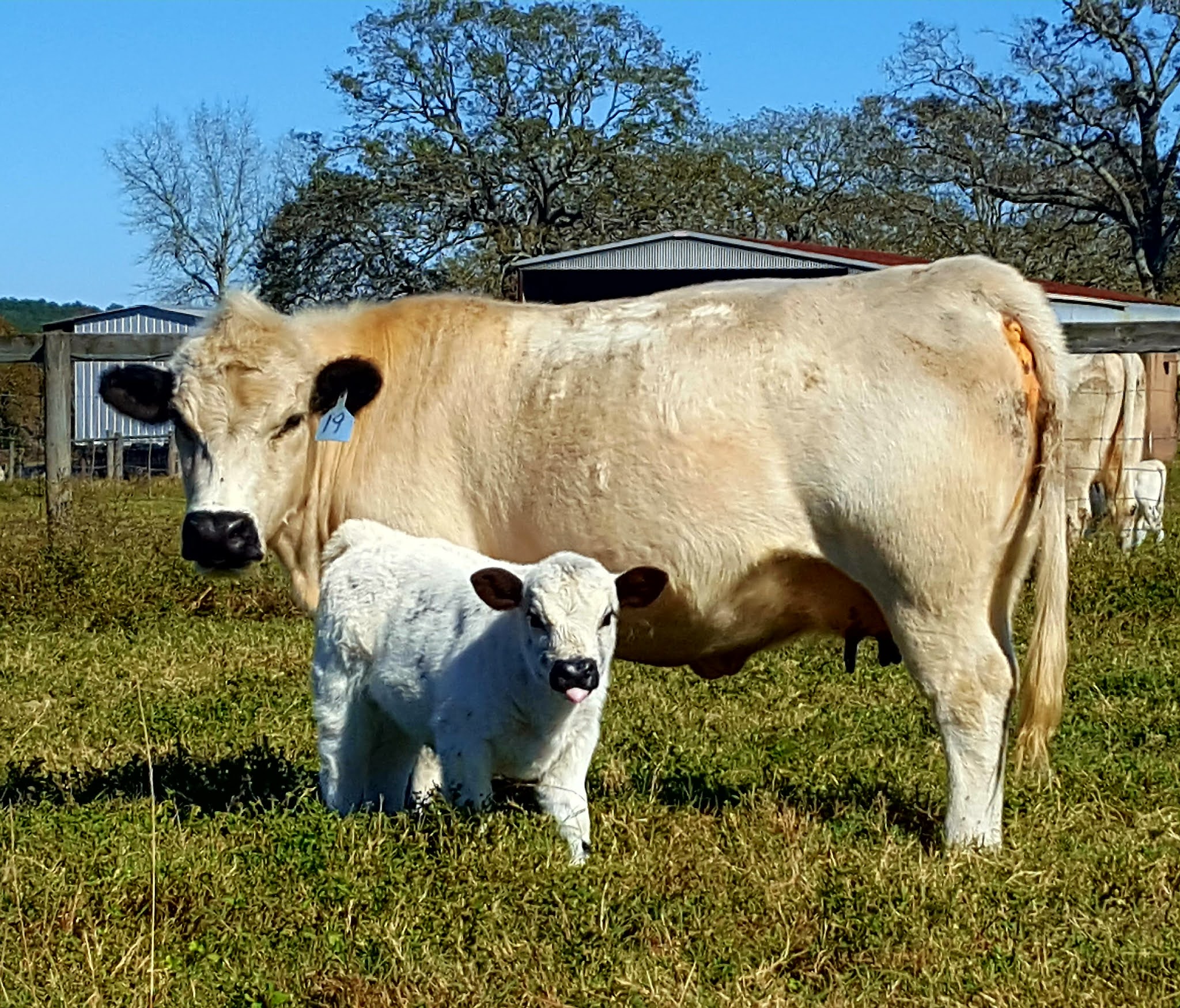
Many thanks to Diamond C British Whites in Smithville, Texas for these photos of her Tom Sawyer sired calves. The first photo shows a newly born bull calf from this past week, having a very nice low birth weight of 64 lbs, with his sister, Diamond C's Taffy, relaxing beside him.  Taffy is about 2.5 months old in the photos.  Both calves are well marked and well made youngsters.  (Visit Lazy A Ranches for a series of charming photos of their Tom Sawyer sired heifer.)

Among British White breeders there are some who perceive a 'perfect' marked British White as one that is a pretty white one with black points and as few spots as possible.  However, historically, as in for several hundred actual years, there has always been varying degrees of speckling and spots about the neck and body in the herds of England of our quite ancient polled 'Park' breed. Even today many of the most revered British White bulls of England exhibit those very traits.

What we all strive to over come is the appearance of the line-backed markings, which are clearly 'over-marked' calves as defined by our breed standards.  Eight or so years ago, when I bought my first British Whites, I was unaware of any prevalence of over-marked calves occurring, or of a stigma attaching itself to the dam, or sire, of those over-marked calves.  I even sold one over-marked bull calf into a starter seedstock herd in my ignorance.  The bull was bought at the side of his dam and was registered, and actually did a fair job of producing nicely marked calves.

Of course, in the beginning, I largely fell hard for the breed's storied history and unique beauty, and bought what I found available to put in my pastures, without any actual knowledge of what I should be asking or looking for in judging the cattle I purchased.  I was quite fortunate to get some really nice foundation animals to start my British White herd.  However, had I been so very judgemental and critical, I would have not have purchased what became significant females in my herd, such as CRae 215G, who had scurs, but was in all other traits an outstanding female; or HRH Bountiful, who is quite spotted, and has had two over-marked calves, one before I purchased her, and another sired by DFTX Watson.  Regardless, I wouldn't think of letting her leave my pastures.  I've no doubt that the two over-marked calves resulted from her genetics, but in a rare breed such as British White, I certainly can live with that.  (Note the linebacked calf in the British White Cattle Society photo below, and the strongly spotted and handsome English bull in their photo above.) 

Today, I find that buyers are much more informed and particular than myself when they approach the decision of choosing the British White breed and in the selection of their seedstock herd.  As well, I am more informed and try to take great care in providing a buyer with all the information of consequence that may impact their buying decision; whether it be scurs present in a cow, an over-marked parent, or an unruly nature.  Eight years ago, I had no idea what a scur was, or that it was undesirable.  I'll never forget my young niece, she was about 11 years old then and my pasture buddy whenever she could come and visit, gleefully pointing out to me all the cows in my herd that had scurs, she was quite proud of herself, and she was remarkably dead-on in her assessment.

I've no idea why now some aspects of our breed are more focused upon than eight years ago, perhaps the breed has made greater strides in the last ten years versus the thirty breeding years in the USA that preceded.  Regardless, this new focus on 'perfect' and zero spot markings is perhaps leading to the dreaded 'single-trait' selection that over time leads to breeding and buying decisions that introduce undesirable traits as to conformation of individual animals, and may as well lead to under-marked animals, such as occurred in the ancient horned Chillingham herd at different points in its storied history.

On the other hand, the education and focus of breeders on rooting out scurs is one that should be addressed; and in fact in England a scurred animal is not permitted registration under the breed standards of their British White Cattle Society.  As scurs are fairly commonplace in our American herds of British White cattle, the eradication of scurs from registered animals would certainly require a structured approach and goodly period of time. 

As well, the Society began a structured closure of their breed-up program in 1996, in order to ". . .further continue the process of ensuring that the British White remains true to the type that has graced our countryside for centuries."  This very topic comes up from time to time among our members, but is generally tabled as just not the right time.

**********

The most recent English semen imported to the USA was that of Huckleberry Finn.  Huck Finn has lots of spots, and I don't recall anyone being terribly concerned about that in the odious ordeal most sustained in finally acquiring semen on this English bull.  Use of his semen has declined a great deal as there is a perception that he will mostly give you over-marked calves.  However, only one over-marked Huck Finn calf was ever born in my herd; and the fault lay equally with the dam -- one of my original foundation heifers of standard markings.  But, the tendency for Huck Finn to throw over-marked calves is certainly present in his genetics, as I learned in England that his dam was in fact an over-marked pedgiree English female.

That said, generally an over-marked animal is the result of a 'nicking' of similar genetics with the female he is mated with.  Probably one of the single most important questions breeders should ask about animals they are considering purchasing, is whether the animal has any overmarked females in at least the prior four generations, on either the dam or sire side.  Relatively new breeders such as myself would not be able to answer that question, as it is not revealed on registration pedigrees; and I breed just as blindly as everyone else with my older females.  This information would require a call to the BWCAA and a look up of individual animal records.

If you're really interested in trying to understand why within the British White breed there are speckled, roaned, and line-backed animals born to standard marked parents -- I recommend a close reading of the in-depth research on the genetics of color presented by the Double Helix ranch, a prominent breeder of Texas Longhorns.  The English Longhorn and the horned White Park were inter-bred in their long history -- the horns of the Longhorn leaving their mark on many examples of the horned White Park today, and the color pattern of the horned White Park leaving its mark on the English and the Texas Longhorn today.


  Moorside Black Knight, Sire of Hevingham Polaris, Gr. Grandsire of Tom Sawyer
Hevingham Polaris, Awesome Sire of Huckleberry Finn, Grandsire of J.West's Tom Sawyer, Follow this link for a photo of an aged Polaris at pasture, note he is blue-skinned and does have speckling.
 
De Beauvoir's Huckleberry Finn, Sire of J.West's Tom Sawyer


J.West's Tom Sawyer
  
J.West's Zeus, Son of Tom Sawyer, Maternal Grandson and Paternal Gr. Grandson of Popeye
  
Lazy A's Little Beauty, Daughter of Tom Sawyer, Maternal Granddaughter and Paternal Gr. Granddaughter of Popeye

(For a nice selection of photos of examples of British White cows and bulls in some of the herds of England, visit this Bohaty's British White page.)

Monday, February 8, 2010

Henry VIII and his Destruction of English Monasteries in the 1530's

The Park Cattle of the British Isles have long been associated with the herds of various ancient abbeys. What's never been mentioned is the historical impact on the movement of the breed following the wholesale destruction of abbeys, monasteries, and priories during the time of Henry VIII, including Whalley Abbey. King Henry took possession of the inventory of the multitudes of abbeys and as a consequence their cattle would have been confiscated and no doubt disposed of in a variety of ways, including placing cattle herds in the hands of nobility, and including no doubt wholesale slaughter of cattle herds and salting of the beef for the King and his nobility. Even the personal dwellings, household goods, and clothing of friars were confiscated and sold to raise money for King Henry's coffers. Wholesale destruction of religious houses and the dwellings of monks and friars was seen across the whole of England. Dozens, if not hundreds, of religious figures were hanged, and often boiled and quartered and hung.

In an example of dastardly political strategy very much still practiced in modern day, King Henry VIII began this wholesale destruction and robbery under the guise of official 'Visitations' to the Monasteries in 1535. At the same time he had rabble rousers under the guise of 'preachers' appealing to the masses with lies and promises in an effort to secure popular support for the destruction of the monasteries and the establishment of his new Church order with himself as the head.

" . . and preachers were commissioned to go over the country to educate public opinion against the monks. These were of three sorts apparently: 1) railers who orated against them as hypocrites, sorcerers, and idle drones, etc. . . 2)preachers who said the monks made the land unprofitable, and 3)those who told the people that if the abbeys went down the King would never want any taxes again. This last was a favourite argument of Cranmer at Paul's Cross.

The very fabric of medieval England was forever changed. The society of England up until this time was very much supported by the stability and charity and grace of the thousands of religious houses throughout England. These monasteries were the critical support for the poor and the lower classes (commoners) of England. Pasturage owned by the monasteries was available to the commoners, so generally each family had a milk cow, some sheep, and a horse. Once the lands of the monasteries fell to Henry VIII and were sold to nobility, those lands were generally withdrawn from use by the commoners.


To read more about this critical and bloody period in England's history, see "Henry VIII and the English Monasteries" by Cardinal Francis Aidan Gasquet, 1906


In April 1537 the popular discontent manifested itself in a serious way in Norfolk. Men met in the streets of Walsingham . . .One man said "See how these abbeys go down and our living goeth away with them. For within a while Burnham shall be put down and also Walsingham and all other abbeys in this country. And further he said that the gentlemen there had all the farms and all the cattle in the country in their hands so that poor men could have no living by them."

Thursday, February 4, 2010

California is always cutting edge aren't they? Cap and Trade

        !Well, here we go, some interesting first steps in measuring the methane produced by cattle.  Production of beef cattle, including maintenance of breeding stock, on a grass and legume diet is becoming more clearly every day the safest approach to seedstock and beef production -- as in safer for your pocket book in the years to come.  Cattle on grain produce more methane than cattle on grass.  Unless you have a vast forest to offset perhaps the dastardly global warming impact of your grain supplemented herd, it's time for increased focus on grass production of seedstock. 
         Superior Feed Efficiency of your seedstock herd is going to be vital to your success at grass-based seedstock as well as beef production.  The photos included here are of my mature herd and were taken a few days ago.  They are content and browsing on old dry grass, but mostly on the young native grasses and clovers that responded well to the sunny winter weather we had in East Texas on the heals of very nice rainfall.
         These girls also have round bales of average quality bahia grass hay, but they've dropped their consumption tremendously over the past few weeks.  They also receive a ration of alfalfa hay three times a week that generally equates to about 20 lbs for each female.  Unless you are individually feeding a cow either supplemental alfalfa or grain, it's always going to be strictly an estimate on per head consumption. 
          Purchasing alfalfa hay by the truckload direct from the farmer is generally the best approach for getting quality hay at a fair price.  As well, the per ton cost of alfalfa hay, delivered, easily competes with the average cost of a basic 20% protein bag of grain cubes, which run about $7/Bag, or $280 per ton in my area.  Even buying the grain in bulk only results in at most a 10% cost reduction for a ton of grain feed.  And most aggravating of all, to my mind, you have to practically live in the feed store picking up food, or build a real swank barn that can hold a lot of grain bags and hope the mice or the weather don't find their way in.  (Pictured above is J.West's Nell Opal 07, a Mazarati daughter, and a heavy bred heifer handling herself quite well with the big girls despite growing both herself and her calf on a zero grain diet.  Notice she has a 'poopy' tail from the watery young grass and clover in her February diet.)


California To Measure Methane To Pinpoint Emissions

02/03/2010 10:13AM  (Please follow the blog title link above for the full text of this AP article.)

California plans to install a network of computerized monitors to measure methane emissions from regions that are home to dairy ranches, farms, landfills and other sources.

It will be the first network of its kind in the United States and will help the state take another step toward reducing emissions of the gases related to global warming.

By May, seven devices about the size of a personal computer will be placed in regions of the state where methane emissions are believed to be the highest. Those include the farm fields of the Sacramento and San Joaquin valleys and landfills in the Los Angeles basin.

"What we'll be able to do is to find the identity, the location and the strength of methane emissions within the state," said Jorn Herner, the scientist managing the program at the California Air Resources Board. "This is new and pioneering work."

The air board spent about $400,000 on the devices and software modeling to analyze the data.

The National Oceanic and Atmospheric Administration, NASA, academic research scientists and other countries have deployed similar monitors in the last two years to track greenhouse gases around the globe.

California's approach, scientists say, is the most extensive effort to gauge local emissions. The information gleaned from the monitoring system is expected to inform state regulators who are charged with implementing the state's landmark global warming law, which Gov. Arnold Schwarzenegger signed in 2006. . .

. . .California's global warming law, known as AB32, requires the state to cut its greenhouse gas emissions by about 25 percent over the next 10 years. Methane, which is 21 times more effective at trapping heat than carbon dioxide, is the most prevalent greenhouse gas behind carbon dioxide.

State regulators currently rely on power plants, oil refineries and others to report their own emissions. That information is used to compile California's greenhouse gas registries and will determine which polluters must buy emission permits under a state cap-and-trade system now being crafted.

Under such a system, companies that cannot cut their emissions because of cost or technical hurdles can buy pollution credits from companies that have achieved cleaner emissions. . . .
. . .Providing a more accurate accounting of emissions should build confidence in carbon-trading markets, said Michael Woelk, Picarro's chief executive.

". . . These devices will tell real time, minute to minute, what your emissions are," Woelk said. "The free market has to know whether this stuff is working in real time, or the credibility is pulled out from under it."

Copyright 2010 The Associated Press. 

Saturday, January 30, 2010

Spring Calving - Care of Newborns

Spring calving is just around the corner.  The following article addresses getting the newborn calf breathing well.  If your cow or heifer has had a lengthy calving ordeal, the newborn may need help even if it appears to be breathing. 

01/29/2010 

Delayed passage through the birth canal in the face of a faltering placenta compromises oxygenation of the calf. Although the calf is able to breathe as soon as its nose passes the lips of the vulva, expansion of the chest is restricted by the narrow birth canal. This situation is seriously aggravated when continuous forced traction is applied. As soon as the calf's head has passed the lips of the vulva, traction should be interrupted, the nostrils cleared of mucus and cold water applied to the head.

Again, when the calf is completely delivered, primary attention is directed toward establishing respiration. Mucus and fetal fluids should be expressed from the nose and mouth by external pressure of the thumbs along the bridge of the nose and the flat fingers underneath the jaws, sliding from the level of the eyes toward the muzzle. The common practice of suspending the calf by it hindlegs to "clear the lungs", must be questioned. Most of the fluids that drain from the mouth of these calves probably come from the stomach, and the weight of the intestines on the diaphragm makes expansion of the lungs difficult. The most effective way to clear the airway is by suction.

Respiration is stimulated by many factors, but only ventilation of the lungs, allow us to render help immediately. Brisk rubbing of the skin and tickling inside the nostril with a piece of straw also has a favorable effect. The phrenic nerve can be stimulated with a sharp tap on the chest slightly above and behind where the heartbeat can be felt.

Source: Glenn Selk, Oklahoma State University Extension Cattle Reproduction Specialist

Friday, January 29, 2010

Full Moon on the Trinity River - and did you know tonight's full January moon once belonged to February?


Above, a nice rendering of the the Trinity River and a Full Moon from an old book on Texas history, click the image for the full text.  Below, comments on February weather from 82 years ago.

The Weather for February - (The Farm Journal, Phil., PA, 1918)
        The story reads, " Then came old February, sitting in an old wagon, for he could not ride," perhaps because he was so abused, for February has always been a much abused month. The year used to begin with March, and February was last. February then had one day less than any other month, or twenty-nine days. In 1752 the month was shifted to its present place, and the new year began in January.  
        When old Emperor Augustus wanted to add an extra day to the month bearing his name, it was taken from February, the month least able to spare it. In 1866 they even took away February's full moon, giving January two and March two. No such thievery had ever been practiced on any month before in history. Astronomers have apparently made better laws since then, for they promise that such.a thing will not befall any month again for 2,500,000 years. So February will have a full moon every year during our lifetime, anyway.
     In an average February half the days are cloudy ; this year the sun will not be seen the first five days of the month—at the north pole. So the groundhog will not see his shadow there when he comes out of his hole February 2. See how his forecast works this year. He always consults his own comfort when he makes his exit from winter quarters too soon. Our average February temperature ranges from 7° in Minnesota to 65° in Florida.
" February fill the dyke
Either with the black or white ;
If it be white it's the better to like," 
expresses a prevailing opinion that a snowy February means a fruitful year. There is much truth in the saying, for heavy snow has a good effect on the soil. Look for the first robin the last of the month. A better indication of spring is a box of early tomato plants, a seed-corn tester or a chilled lamb in the kitchen.
 
J.West's Colonel Beau at 22 Months Old, Owned by Al & Dalene Ross