Saturday, March 23, 2013

Controlled Substances Act Newly Applied to Large Animal Vets


The D.E.A. wants Y.O.U. to have to haul your cow or horse to your vet, or at least that's my read on this, and that of course would be a real burden to the cattle raiser, if not impossible in many situations.  Of course, I could just be paranoid - and in no way is this a sly first move toward a long range goal of creating another headache or stumbling block for the beef growers and beef eaters in the USA in the interests of curtailing both the growing of and consumption of that beef.

There appears to have been a 2012 reinterpretation of the Controlled Substances Act (CSA).  Or maybe not a reinterpretation, but a reinvention of how to interpret it?  Some government employee with outstanding ability to read between the lines and in to the psyche of the original crafters of the CSA in 1970?  Or some one or group who got a big high five from upstairs for finding yet another way to cause difficulty for livestock producers in the United States?

It seems that back in 2012 the Drug Enforcement Administration (DEA) stepped in to regulate the movement of certain substances used in the normal course of business for a large animal veterinarian. In the state of California vets were notified of the 'new rules' by June of last year.  From everything I've read so far, it is only California vets that received DEA notice of "illegal" acts, which strikes me as odd, maybe it was sequester budget savings in advance?  Like if they put the squeeze to CA, the rest of the country's vets will get the word, save a little paper or something?  Couldn't find a pigeon perhaps?


  •  "The act apparently has not been applied to mobile veterinary practices until recently, but the Drug Enforcement Agency (DEA) appears to be changing its practice this year, as mobile veterinarians in California report that they have received notices that their activities are illegal." June 2012, DogZombieBlog


The DEA's target is the mobile vet, the one that comes to your farm or ranch to vaccinate your calves, take a look at a sickly cow or horse, palpate your cows, etc. . . It is certainly not a new concept, and I've no doubt there were lots more vets in 1970 who were "mobile" caregivers than there are now.  There are fewer and fewer large animal vets coming out of our universities now than ever before; yet, now, the DEA suddenly decides they've been overlooking a dangerous avenue of drugs they are compelled to leash with greater regulations in the year 2012?  What a puzzle.

From the March 14, 2013 issue of The Weekly Livestock Reporter we learn that:


  • "Dr. Thomas W. Graham of Davis, CA, told the American Veterinary Medical Association he had been contacted by the state's DEA and had stopped carrying pentobarbital, diazepam, xylazine and butorphanol in his vehicle because he was told it was illegal.  Graham is a large animal vet . . . He told the AVMA in a report that he is using a handgun for euthanasia until he is assured he can carry what he needs into the field to euthanize an animal."    "Graham is walking a fine line between following a law that is murky at best, and treating his patients as humanely and professionally as possible.  As word of the DEA notices spread to other states, outrage has continued to grow about the rule."

U.S. Representative Kurt Schrader, D-Oregon, is a veterinarian, and one of seventeen members of Congress who wrote to the DEA in October 2012 regarding this power grab by the DEA and its impact on vets.  There has not been a response in writing from anyone in the U.S. Government.  I suppose those seventeen members of Congress elected by the people simply don't have the clout to warrant a timely response from the DEA.

Schrader said, "Not a single member of Congress intended the CSA to be used as a means of restricting the practice of mobile vets.  The DEA has no clue what it means to drive the countryside providing veterinary care and protecting our food supply." Schrader added that "the DEA's interpretation of the CSA gives him pause as to how much leeway agencies like this should have.  He says legislation is being drafted to correct the problem, and within a month or so that legislation should be introduced."

In the meantime, the DEA says "that it is not legal for veterinarians to use controlled substances outside of their registered locations."  So . . . euthanizing with pentobarbital on your horse's home turf becomes out of the question, sedating an injured cow with diazepam or xylazine on farm to safely treat the cow (safer for the cow and the vet) is out of the question, and if your horse is having a severe colic, or has a severe injury of any sort that would call for a good pain reliever, I suppose you'll have to somehow get him loaded in to the trailer for an office call to get some butorphanol . . . 

Hmmm . . . I think I'll go grab a couple of aspirin for this headache while I still can.

Tuesday, January 15, 2013

Our Christmas Miracle - A Thankful British White Heifer

Meet this gutsy little heifer who controlled our daily lives for several weeks, starting the week before Thanksgiving and continuing on through the New Year.  Her name is now Thankful, and she is grateful for our efforts I'm sure, but Holiday might be a good moniker for her as well, as she certainly took over our holiday season from Thanksgiving to the New Year!  Thankful hung her rear legs in a hay ring in surely the most awkward and puzzling way I could ever have imagined.  It was one of those sturdy green ones from Tractor Supply, certainly doesn't look like a potential death trap to yearlings . . . but strange things happen around here!


It was almost a full two days after her injury before she would eat or drink.  Cows have such endurance and tolerance for pain, even the yearlings, it's hard to say whether she wouldn't eat because she was in silent pain, or she was super ticked off at not being able to walk and she was purely sulled -- most likely a bit of both I'm sure.  My miracle cure to perk up Thankful's appetite was a big syringe of pure Louisiana cane syrup that first night, and she was eating finally by the end of the next day, and perhaps more importantly, she would finally drink.


The picture above is in the first week of her injury.  You can see one of two different splints we tried on her right rear leg . . . hard to say whether either attempt was helpful to her, but it did stop her from trying to crawl on a flipped backward ankle and perhaps creating more damage.  We weren't even clear on just what was wrong with either leg, but the right rear weakness seemed to be her hip at issue as she had full retraction in the leg.  It wasn't until about the 2nd week or so in to the injury that her hair started slipping on the left leg and I realized it was an oozing infectious mess underneath her skin to be sure.  The circulation was cut off to both legs trapped in the ring, her limbs were cold and hard when we found her that morning, and I'm guessing maybe it just like killed the skin?  Just don't know.  The vet didn't even notice it when he was here after Thanksgiving, otherwise I'd likely feel guilty for missing that damage so long.


My choice of bandages . . . duct tape, and lots of it, over big gauze pads, it worked pretty good if you wrapped the top and bottom several times.  I finally had to actually trim away a large section of her dead hairless hide . . . I suppose I was looking at raw muscle under there.  I had no idea how all that was going to play out and tried real hard not to let my imagination get away from me there.  And, no, I did not call the vet again.  When he saw her the first week he only gave her at best a 20% chance of a full functioning recovery . . . if he saw that mass of exposed red meat I was doubtful he'd leave me with that 20% of hope I was working with.


During that first week she started managing to move about the pasture in sort of a crawling-hop, and mostly she managed to move about in a downhill least-resistance direction.  So by the morning of Thanksgiving Day she had landed right up next to a big woodpile at the bottom of the slope and we knew we'd have to find a way to move her away from there. Given her bad luck the whole pile might just come tumbling down on her if she tried to maneuver herself around about the woodpile.

After a lot of arguments and ideas, we finally settled on using the hay tarp straps to cinch Thankful up and pick her up with the hay forks to move her to a safer place. Mike as always was as willing and determined to get the job done as ever when we have a man-sized dilemma with the cows.  Normally, I say something not very nice under my breath when I encounter one of his knots on something about the place that I have to deal with -- this time I was happy in knowing he would tie some really good knots in those tarp straps to hold her in for her tractor ride.


We were able to move Thankful about 100 feet towards the edge of this pasture, and likely that's as far as this method of moving a heifer is good for because of the body compression from the straps.  Mike also kept the tractor moving very slow to keep any stress on her over the bumps and hollows of the pasture to a minimum.  Thankful didn't seem bothered by her adventure, she never got agitated at all, and just seemed to think it was all part of this new strange chapter in her life.  You see her below just after we got her settled in along the pond fence with hay and water, and if you zoom in on this photo you'll see some creative hay string at work to repair the fence . . . life on a hay string  . . . it's not so bad!


Over the days that followed Thankful began to move mysteriously about during the night, and we'd find her greater and greater distances from where she'd been fed the night before. Curiously, she kept herself going around the perimeter of the pasture, following the fence line, until she'd reached all the way to the top end of it, saying hello! to all the traffic on US 69.  At this point she'd been travelling up hill for some days -- and then she started back down and around - she seemed to have a travelling plan and she wasn't going to let any grass grow under her feet if she could help it.  Did I mention she is a very gutsy little heifer? 

This went on for some weeks and Christmas arrived and we clearly weren't going to be going anywhere as Thankful still depended on us to bring her hay and water where ever she landed.  About a week before I'd managed to get her moved from the pasture she was injured in to the next one and on from there to a trap  area that would contain her to smaller digs.  It took some grit from both of us to do that, she could only move a short distance at a time, then she'd rest, then I'd prod her to get back up and I'd help support her weight on her right rear side as she hobbled a ways and then gave out and rested.  We eventually made it to our destination, and we both were well pooped out.

We spent Christmas here at home, which is always fine with me, but it turned out to be one of those you don't want to ever recall so you just block it out and go on down the road.  A runaway freight train rather than Santa Claus actually arrived on the Eve of Christmas here on this beautiful hill in the Pineywoods we call home, and seeing the arrival of the break of day on Christmas morning was a blessing.  But even more of a blessing was discovering that Thankful suddenly had found the use of her right rear leg.  I will always believe that it was the gift of a miracle for both of us, a sign of hope for the future.

Below you'll see a video of Thankful on New Year's Eve. It took some days for my brain to believe what what my eyes had been telling me since the day after Christmas, days to even say to Mr. Brown, my very special right hand man who helps me here, look at her, can't you see! she's better!  Like me, he had shaken his head and given up on her to make any more progress just a couple weeks before.  But also like me, once he really looked, he saw it too, and I knew it wasn't just me being hopeful or too positive, or any of that.  She was really better, much better!   

Here is a video of Thankful on New Year's Eve, and pardon the music, but I thought she deserved all that clapping . . .


The video below is of Thankful just 3 days before Christmas.  I took this video to send to my vet to show him she was NOT progressing and to see if he still was agreeable to taking her to his place and then harvesting her for beef . . . ouch.  Some of you may think that is really awful, but in fact it was to my mind the most humane way to deal with her if she wouldn't recover well enough to carry a calf.  I certainly wouldn't have wanted to take her to a sale barn or try to find someone to put a bullet in her head and then ask Mike to please honey bury her.


Thankful continues to get better and better.  She was running and cavorting with this cold weather today, and I saw her literally hop up and down with both rear legs in sync!  She shows every indication that she will make a full recovery.  My vet did add when he gave me that 20% of hope for her all those weeks ago . . . that it didn't perhaps apply to me as I lived things longer than anyone he new . . . a reference I'd imagine, didn't ask, to my old and beloved Fred, who came to me on a Christmas Eve twenty one years ago . . . we do miss him.

Wishing everyone a happy, healthy, and prosperous 2013!


Tuesday, January 1, 2013

Bakewell's Optimal Cow in 1856 . . . sounds a lot like the British White cows in my pastures today!


Excerpt from:  The American Farmer, Vol. XIV, 1858, Pg. 57
J.West's S.S. Carter sired heifer calf from an El Presidente daughter 
We find the following in Rural New Yorker extracted from the London Quarterly Review for April 1856

". . . The cattle of ancient days were chiefly valued for dairy qualities or for draft, and were only fatted when they would milk or draw no longer. The greater number of breeds were large boned and ill shaped, greedy eaters and slow at ripening, while as very little winter food was raised except hay, the meat laid on in summer was lost or barely maintained in winter. Fresh meat for six months of the year was a luxury only enjoyed by the wealthiest. 

      First class farmers salted down an old cow in autumn, which with their flitches of bacon, supplied their families with meat until the spring.   Esquire Bedel Gunning, in his Memorials of Cambridge, relates that when Dr Makepeace Thackeray settled in Chester about the beginning of the present century, he presented one of his tenants with a bull calf of a superior breed. On his inquiry after it in the spring,the tenant replied, "Sir, he was a noble animal, we killed him at Christmas and have lived upon him ever since." 

      The improvement of the breeds of live stock is one of the events which distinguish the progress of English Agriculture during the last century. Prominent among those who labored to this end was Robert Bakewell of Dishley, the founder of the Leicester sheep. He also had his favorite long horn cattle and black cart horses, and though he failed in establishing these he taught others how to succeed.

     Surrounded by the titled of Europe, he talked upon his favorite subject, breeding, with earnest yet playful enthusiasm, there utterly indifferent to vulgar traditional prejudices, he enumerated those axioms which must be the cardinal rules of the improvers of live stock. He chose the animals of the form and temperament which showed signs of producing the most fat and muscle, declaring that in an ox all was useless that was not beef, that he sought by pairing the best specimens, to make the shoulders comparatively little, the hind quarters large, to produce a body truly circular, with as short legs as possible, upon the plain principle that the value lies in the barrel and not in the legs, and to secure a small head small neck and small bones.

        As few things escaped his acute eye he remarked that quick fattening depended much upon amiability of disposition, and he brought his bulls by gentleness to be as docile as dogs.

. . .  But fine boned animals were not in fashion when Bakewell commenced his career, and to the majority of people it seemed a step backwards to prefer well made dwarfs to uncouth giants.

 . . . In 1798 the Little Smithfield Club was established for exhibiting fat stock at Christmas time in competition for prizes, with a specification of the food on which each animal had been kept. This Society has rendered essential service by making known the best kind of food, and by educating graziers and butchers in a knowledge of the best form of animal. 

      In 1806, in defiance of Mr Coke's toast, "Small in size and great in value," a prize was given to the tallest ox. In 1856 a little ox of the Devon breed of an egg like shape, which is the modern beau ideal, gained the Smithfield gold medal in competition with gigantic Short Horns, and Herefords of Elephantine proportions.  In 1855 a large animal of Sir Harry Verney's was passed over without even the compliment of a commendation -- because he carried on his carcass too much offal and more threepenny than nine penny beef."

(Note: Reprint of J.West 2007 topic)

Monday, December 31, 2012

HAPPY NEW YEAR 2013!!


Best Wishes for a HAPPY NEW YEAR!!!

from J.WEST CATTLE COMPANY

Fall 2012 Carter Sired Calves from El Presidente Daughters

Saturday, December 15, 2012

A Pair of Champions - British White Steer and His Showman!

British White Steer at 2012 Fort Bend County Fair in Rosenberg, Texas


Grant and British White Steer - Titus - Fort Bend County Fair
September 2012 - Both of these boys are champions. . . .

We all learned recently that the BWCAA board voted to award a monetary premium to kids who show British White animals and win champion in their class.  I have to say I find it a bit of an underwhelming and an ineffectual token effort at supporting or promoting the breed.  The fact is most kids take a huge risk of their time, effort, and money to show a British White heifer or steer.  So far as I'm concerned, these kids who stubbornly stick to their guns with their Ag teachers and parents and 4H advisers who vehemently counsel them NOT to choose a British White -- those kids ought to get an award of financial help from the BWCAA, not just a breed champion winner.  These kids are WINNERS simply by virtue of stepping out of the box and showing a British White animal!

Grant is just such a winner.  Grant took a grassfed steer out of the pasture and turned him in to a beautiful shining example of the breed.  Titus had been long since weaned, probably a good four months, and turned out to winter hay and alfalfa rations.  His counterparts in this steer competition most likely all came from grain backgrounding programs aimed at pushing their growth before they were even off their dams, halter broken at a young age, and made available as show steer possibilities right from the jump.  So that difference in background feeding was an enormous hurdle that Grant and Titus had to overcome and it was quite a challenge.  As for halter breaking - Titus was awesome about that, and Grant was quite happy with the ease of working with him and by all accounts Titus just loved all that attention. 

Titus was an American Fullblood sired by J.West's El Presidente and his dam was J.West's Brigit, a King Cole daughter.  While Titus did not place, the judge couldn't find a criticism to make of him that I could hear - except to say he would be a top contender in the group if he had had 60 more days of finish on him.  The judge did not even acknowledge that Titus was a British White!  Perhaps he did not know.  Hmmm....... Is that lack of breed awareness or respect my and my fellow small breeders' responsibility or fault?  Or is it the Association's lack of support in promoting our breed to the mainstream cattle industry?  If they don't find the cattle worth the monetary risk of supporting and promoting them - who will?

Titus in April 2012 at the School Barn
So far as I know there are no wealthy individual members who can hire a marketing firm for promotion and education or single-handedly orchestrate a steer test or British White show and sale for the benefit of all members and the breed.  And for certain, we small breeders can yak all day long about how awesome we find our British White cattle, put up nice web sites, take good photos, give away meat from our freezers, even practically give away bulls to get someone to try the breed - but that doesn't cut it in the long run because it is not data - real data - on the merits of the breed - and cattle are business - and successful businesses operate on supportable facts - not the fairy dust of words or opinions.  

Below is a video of Grant and Titus' big day at the fair. This was Grant's first effort at raising and showing a steer.  He learned a great deal in the process, and I did as well, as he kept me abreast of the feeding regimen and weight gain as things progressed, as well as shared lots of amusing stories of Titus' good-natured antics.  I was very proud of him and his steer.  Grant didn't get Titus until late in the game, and that no doubt contributed to the lack of finish the judge observed, and I didn't help any by trying to get Titus transitioned to grain from grass a bit too fast.  That was a disaster to say the least, and Titus looked woefully thin and not at all a show contender.  Despite how pathetic Titus looked when Grant picked him up, I think he and I both hung on to the picture of him in our minds of how he was just weeks before and what he could be.    

Youngsters like Grant with a strong passion for the breed who resolve to show them against all odds and advice are the future of this breed - and each one should be applauded and awarded for their efforts.  And no doubt devoted Mom's like Grant's mother, Darlene, would certainly appreciate the acknowledgement of the very special grit and determination of their kids who insist on showing a British White.


Back to this new premium for showing winning registered BWCAA animals - I would also add that most kids will only ever be able to receive the lowest "premium" of $100 that is designated if "breed consists of 1 animal" and they are blue ribbon winners by default, as you will rarely find a show with more than one British White animal.  And further, the fair authorities would have to give you your own breed category!  Of course, if it is one heckuva steer or heifer, perhaps they might when "Champion Other Breeds" - one can always hope.  And also, I noticed it had to be a State Fair.  What's up with that?  Showing starts at the ground up, just like a political race, and it would appear the smaller county fairs that lead up to State Fairs just don't cut the mustard.  Unfathomable....

If the BWCAA can afford to waste about $2K on a useless and wholly unnecessary compilation and review (there is no such thing as a "review audit") and now another $2K? on officer's liability insurance each year - then surely our BWCAA member fees can be allocated a bit more generously to these FEW youngsters across the USA who stubbornly take on the world to show their British White steers and heifers.  


Wednesday, September 12, 2012

British White Cattle Mugs, Shirts, Cards, Magnets and More - Unique and Original


British White Cattle Originals - Unique Gift Items


I have created lots of British White items on Cafepress.com with cow photos, particularly my old Wanda Mae, an outstanding British White cow.  Below are a few examples of the items available, and I hope to have more in the future, so be sure and check back!

You can visit the shop at www.Cafepress.com !!!  Thanks for having a look and let me know if you are happy/unhappy with the products, have suggestions, etc...


British White Cattle Herd - Large Mug
British White Cow Herd Behind the Fence - Mug Available on CafePress


British White Cow - Color #2 Large Mug
British White Cow  - Large Mug Available on Cafepress

British White cow at Pasture - #3 Women's T-Shirt
British White Cow T-Shirt Available on Cafepress


Wednesday, August 15, 2012

Ancient Kuri Cattle of West Africa & and the Park Color Pattern


This quite powerful and stunning image made me gasp and my jaw dropped with a stunned 'OMG'.  It was kindly sent to me by Andrew West of Cornwall, England.  Andrew tells me in regard to the caption for this image ". . . roughly translated it says they are `Gehornte Kuri-Rinder from the Buduma Area of West Africa`.


Kuri-Rinder from the Buduma Area of West Africa

If ever there was a photo or painting that made one immediately think of the kinship between the ancient auroch and both the polled and horned white Park cattle of today - this one would be it.  The distinct color pattern - which is commonly referred to as the Park color pattern by geneticists today - is a color pattern found across the world in highly distinguished breeds of great antiquity and tradition.  The Kuri is clearly another such breed, and I am pleased to have had it brought to my attention.

These Kuri Cattle have a quite mild demeanor (they are used for both milking and beef) about them in the image above and look to be moderate in size.  The average birth weight of Kuri calves is just over 50 pounds, with the females weighing about 950 lbs. Their horns are reminiscent of the depictions of the skeletal remains of aurochs.  Note the very large diameter of the base of the horns in this skeletal image.

Aurochs bull at the Zoological Museum in Copenhagen from 7400 BC

"Kuri
 cattle are predominantly white although various colours are often present. Kuri owners seem to have a general preference for white breeding bulls. The distinguishing characteristic of the Kuri breed is its horns: they are immense, consisting of a lightweight fibrous material with a spongy interior and a very thin external shell."  (The unique Kuri cattle of Lake Chad BasinNtombizakhe Mpofu and J.E.O. Rege,  2002)
Today the predominant cattle type in Africa is Zebu based, or bos indicus. But -- it is widely held that the indigenous cattle of Africa were bos taurus.  DNA studies of a wide variety of cattle breeds in Africa, including the Zuri, confirm that the Zuri is in fact of bos taurus descent.
"African cattle are believed, from prehistoric artistic representations, to have been Bos taurus (taurine) in morphology. . . The indicine (bos indicus) allele was observed in all West African breeds (including taurine breeds like the N’DamaMuturu, Somba, Kapsiki and Namchi) except the Kuri and shorthorn Lagune breeds." ( Mpofu & Rege, 2002)
The Zuri apparently have a unique adaptation to their native hot and humid environment.  They are excellent swimmers and often are led across portions of the waterways of Lake Chad by their herdsmen to reach new grazing areas, even grazing in water to eat fresh grass or sea grass, that tops the surface.  Their horns, while being massive and distinctive, are actually quite light in weight and thought to be an adaptation to their native environment of many thousands of years.
"Although the horns are generally very light, approximately 1% of Kuri cattle have such heavy horns that their heads are, to some extent, tipped up by the weight. It has been suggested that, by tipping back the head, the weight of the horns keeps the nostrils out of the water when swimming. The bulbous base and spongy interior of Kuri horns are assumed to be an adaptation to aid buoyancy when swimming. Some selection within the Kuri has resulted in other horn shapes such as lyre- or crescent-shaped horns."   ( Mpofu & Rege, 2002)
"In the dry season, the animals follow their herdsmen in swimming through the waters from island to island in search of waterweeds as feed . . . There are tribes who move their cattle to upland areas during the peak of the wet season and return them to the lowlands in the dry season . . . Animals are generally divided into transhumant and non-transhumant herds. The latter are comprised of lactating cows (and their calves) which are left to provide milk to the children and older people who stay behind to fish and farm. Transhumance is, however, limited to the environs of the lake, probably because of the susceptibility of the Kuri to sunlight and heat and its limited ability to trek long distances."  ( Mpofu & Rege, 2002)

I've read lots and lots of old articles from the early to mid 19th century and beyond that debated the notion, or myth, that the horned white Park cattle (primarily the Chillingham herd) that roamed the British Isles were actually some how a singularly pure and direct descendant of the 'auroch' race -- aurochs being the original truly wild and very large beasts that inhabited Europe, Asia, and Africa.   That old myth has been well debunked in the 21st century.  Even so, the color pattern was clearly present in both the European and African auroch.

The Zuri quite beautifully exhibit the Park color pattern, and particularly the recessive red that was the subject of the greatest portion of the first recorded European oral and written histories that reference both the milk-white polled and horned examples of white cattle bearing the Park color pattern.


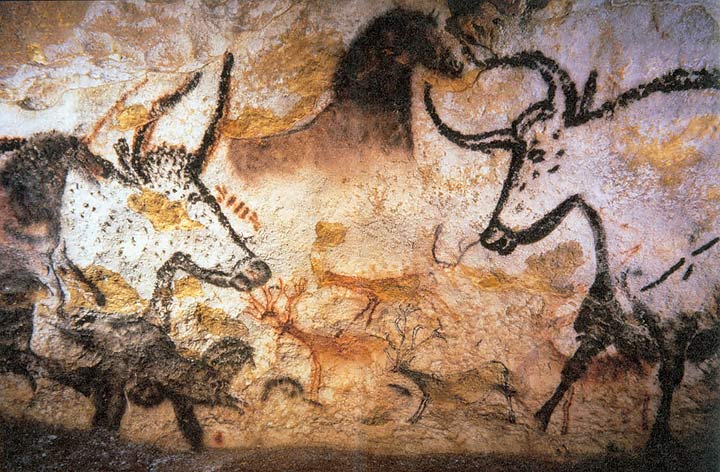
Cave Painting in Lascaux ,France - c. 15,000 B.C.
I've run across representations of cave paintings over the years that included illustrations of white beasts, speckled beasts, and black ones with a white line down their back - which, as discussed in a February blog, has long been known as the Riggit pattern.  What I never realized is those cave paintings are considered to be drawings of the auroch - so I deserve quite a thump on the head for missing that!


Cave Painting in Lascaux, France
You can see in this first photo that the aurochs represented in this French cave painting are white, with darker noses, and actually speckled as well.  And this next one also shows a white speckled auroch, along with a horse and some other type of small animals which are portrayed as brownish in color.  The ears and nose are distinguished as a different color in both drawings, and in the first drawing you can see that the legs are dark - quite like both the horned and polled Park cattle of today.


In 2010 it was reported that an experiment had commenced to attempt to re-create an auroch from breedings amongst those modern day domestic breeds considered to be most representative of the auroch.  In this article from The Telegraph we are told that the Highland of Britain and the ". . . white Maremma breed from Italy," are two of the breeds being used in this experimental "back-breeding".  If you do a web search for images of the Maremma breed, you get results with both white examples and grey examples of this breed, also two different spellings:  Maremma and Maremmana .  Here is a photo of a "white Maremmana" . . . 


Maremmana Cattle
White Maremmana - by Amenon on Flickr

The inclusion of the white Maremma in this experiment certainly indicates that the scientific community considers the Park color pattern to be one of great antiquity that indeed was found in the indigenous aurochs of prehistoric times.  But then, I would think that most every basic, or root, coloration of modern day domestic cattle would track back to ancestral aurochs . . . What I find sad, inexplicable, and irritating is that clearly the milk white auroch of prehistoric times --  as well as the milk white cow of modern recorded history  -- were both highly revered back in days long long gone . . . NOW, they are generally found undesirable here in the USA by the commercial cattle industry . . .  thanks in large part to the promotional success of Certified Angus Beef  and the dominating USA demand for black hided cattle.

The future of British White Cattle continues to be in the hands of largely hobby farmers in the USA.  Their owners are captivated by their beauty and uniquely gentle natures, and of course the quality of the beef.  If you would like to help promote greater awareness and acceptance of polled British White Cattle in the mainstream cattle industry  - visit  the United Kingdom's British White Cattle Society web site for additional information.
Lascaux Cave Painting, France


Tuesday, July 31, 2012

Cattle of Texas - 165 Years or so ago . . .


This letter from President Sam Houston was printed Jan. 1846 in the American Agriculturalist & the Rural New Yorker, Volume 5.  I've included the two recipes that appended the page where I found this letter - just in case any reader is trying to decide what to whip up for dinner........


Indian Cakes.—Boil some corn meal, as mush, for five or six hours; then mix it as a batter, and add some wheat flour to make the cakes hold together and turn easily; and two or three eggs, with salt to season; bake on the griddle till brown.
Mush.—It is very common to make mush by boiling only a few minutes. This is all wrong. It should be boiled one or two hours, and if longer it will do no harm. It will be necessary to occasionally add some water to keep the mass thin and prevent burning.


CATTLE OF TEXAS.

"The following letter of President Houston was addressed to a gentleman in this city, and kindly handed us for publication. It is the best description of Texas Cattle we have yet seen, and we trust its publication may serve to call the attention of stock Breeders to this interesting section of our country.

Galveston, Texas, Dec. 1st, 1845.
No present to me at this time could have been more acceptable than a fine Durham, as it is my intention to carry out the object which first induced my location in this country—that of stock breeding. The present condition of our country, in consequence of annexation to the United States, will leave men free to pursue the more pleasing and profitable business of agriculture and herdsmen, than has been allowed for many years to our citizens, while under the various influences of excitement and uncertainty. Fortunately for us, we shall soon be at rest, when our natural facilities will be inquired into, and our resources developed, by those who have capital and possess enterprise.

   Doubtless no country on earth possesses equal advantages to Texas as a stock-rearing community. Stock here requires no feeding cither in summer or winter, and costs no trouble nor expense save marking and branding. Salting is not necessary, as salines or licks are in every part of the country; so that in fact, an ox weighing one thousand weight, or the most valuable cow, would not cost a farmer one cent in its rearing.

   Our prairies are clothed with the most nutritious grasses, sufficient for countless herds. Heretofore, the Durhams have not prospered in this country; but this, to my mind, is readily accounted for. They have generally come by water, and remained on the seaboard, where the insects are more numerous than in the interior; and where, too, the climate is not so congenial to the constitution as the rolling country, not only of cattle, but likewise of horses. Some Durhams have been introduced from Missouri, and remained in the interior, about one hundred miles from the seaboard, and they have done well.

   There is no good reason why blooded cattle or blooded horses should not do well in Texas, if proper care be taken of them the first year. The change of climate, from a northern to a southern latitude, will have an influence upon all animals, as experience has shown; this fact being known, should not be disregarded, while the animal is undergoing acclimation.  My opinion is, that November would be the most favorable month for the introduction of blooded stock, and that they should be fed on hay or corn-stalk fodder, with very little grain during the winter, and be kept sheltered. If this course were pursued, I am satisfied that there would not be more than one failure in twenty experiments.

Durham Bull, 1856, Purchase a Print Here
   The present stock of cattle in Texas is generally a mixture of Mexican, and cattle from the United States. They each show a distinctness of character. The Mexican (or Spanish) cattle are not so heavy or compactly built, but are taller and more active; nor do they weigh as well in proportion to appearance when slaughtered as the American cattle. They are more active than our cattle, with remarkably long, slim, and sharp horns : they are not so good for milk as ours. A cross of the breeds I consider an improvement, and for oxen decidedly so, for it blends the power of the American with the sprightliness and activity of the Mexican cattle. There is a fact in the natural history of Texas, which has heretofore claimed but little notice, and which seems to me not unimportant.

   When the first colonists, under Mr. Stephen F. Austin, arrived in Texas, they found herds of wild cattle on the Brassos and its tributary streams. There was no tradition of their origin, nor has anything satisfactory on the subject yet been ascertained. They have receded as the settlements advanced, and are now above the Falls of the Brassos (Brazos), and principally upon Little River. They are of a brindle or reddish color, and are represented by those best acquainted with them as more wild, and, when wounded, much more dangerous than the buflalo. The males have occasionally attached themselves to herds of tame cattle, and become very gentle. Calves have been caught by our pioneer settlers, and reared. The cross is said to be an improvement upon our common stock, imparting to their offspring an appearance, in color and proportion, of the wild cattle. The males I have been assured by hunters and other persons, are as large as the finest Durhams. I have seen work oxen, said to be half breeds, much larger than any others which have fallen under my observation in the United States or Texas.
Longhorn Cow in Texas - Wikipedia

   For years past I have endeavored to procure the full bloods; but in consequence of other duties I could not use the attention necessary to ensure success. I will now renew my exertions with increased interest, and I hope it will be in my power to produce a cross of the Durhams with the original Texas cow. Should I be fortunate in my efforts, I shall be happy to apprise you of the result."
Sam. Houston.


Saturday, July 14, 2012

British White Cattle for Sale in East Texas - Have a look at the Herd


Wow, talk about a drought busting stretch of rain!  It was odd to wake up this morning and realize the sound of thunder or rain on the roof had not woken me up all night - as that has been the norm for a stretch of days lasting almost a week.  Some days it seemed we were in the tropics, it would just gently rain and rain and rain all day.  I can't say for sure, but I think we've had at least 9 inches all together - our newly adopted dog decided to see how the rain guage chewed, so the only measure is from a 5 gallon bucket.  I do hope the rest of the country sees some relief soon from the drought, and maybe finds some hope in the pouring rains of the Texas/Lousiana coast that likewise suffered through drought last summer.

Here's a look at some very impatient British White cows, they had let me know a day or so before that they were somewhat irritated at the conditions in the adjoining pasture and were quite ready to move on - and they moved on in a hurry.  Can't say I blame them, the grass was looking mighty fine on the other side of the fence.

Most all the cow/calf pairs offered for sale are in this group.  If there's a particular cow in the video that catches your eye, give me a call, she may be available as well.


Friday, July 6, 2012

Day's Long Gone -

No - It's Not a Pic of a Cow - Working on Finding
One That Would Be Appropriate!
I tend to recall this poem every summer about now, so thought I'd share it again . . . hope all those overwhelmed right now with drought conditions in the USA and around the world, have some relief soon and hear the welcome patter of rain drops on their roof tops.

Slip-N-Slide Junes


It’s hot as Hades in the noonday sun.
Sweat drips and runs and cuts through the dust
Of my reddened face, as my breath comes harsh
In the June heat that once was meant for fun.
I wipe my slick brow, my eyes sting with sweat --
and my hot mind rolls back to days long gone.
. . . in the days long gone of Slip-n-Slide Junes.


We slipped our bums down the wet yellow sheet -
no worries about a third degree burn.
Barefoot and bareheaded we ran through the woods,
no fear of a clearing causing scorch to our nose,
or our brains slow baking like a casserole.
Many miles we walked the neighborhood streets,
never a care that we’d blister our feet.

And mud-puddles! What a supreme delight!
Our bare feet splashing each puddle in sight!
Many’s the time we snuck soft out the door
While the thunder rumbled and the rain still poured.
Our giggles of joy, our screams at the glory,
seem a faint memory in the days long gone.

A rope we would string between two pear trees,
and a blanket we would pitch o’er the top.
And in our TeePee we’d camp for the night,
tell scary stories, play the old Ouija,
tryin’ our darnedest to stay up all night!
Seems a faint memory in days long gone.

Hot are the days, but as well are the nights,
like a smothering blanket of clinging heat -
a hot flash like yo’ Momma don’t need,
like an evil conjure from old Ouija.
It's hot as Hades in the noon day sun -
in the June heat that once was meant for fun.
In Slip-N-Slide Junes of days long gone.


Copyright ©Katie.Flippin 2010, All Rights Reserved


.

Wednesday, June 27, 2012

Thinking of Sprigging a new Pasture? Harvest Bermuda Sod with a Two-Horse Turning Plow Instead . . .

The health of pasture grasses this season, after the really hot late summer drought we had here, is a constant topic of conversation - even if only in my own mind with my own self.  I've seen lots more weeds this year, and some even look like new varieties to me, and some of the pastures are growing thinner stands of grass than last year.  I've been exploring having the back pasture plowed up and sprigged again with one of the new bermuda grasses.  But Ouch, it costs a lot to do, and I don't know that it can be justified except in a hay farming operation where irrigation is available - unless you are really good at predicting healthy spring and early summer rains.  Otherwise, there's lots of risk your money will go right down a dry drain.

Here's a look at an old-fashioned approach to establishing bermuda grass pastures in 1898 Mississippi. 
"You will find it growing well on the sandy soil of the piny woods, and on the red clay hills and on the black lands of the prairie belt.  Since Bermuda grass very rarely, if ever, matures seed in this latitude, the only safe method to propagate it is by transplanting the roots or the underground stems. This should be done in March.
After the land has been prepared as recommended above, then with a bull-tongue or narrow shovel plow open rows two feet apart. With a short spade shave off sod two inches thick; or, a cheaper and quicker method would be take a two-horse turning plow and set it to run shallow, and turn or edge up the sod.  
The sod can then be hauled in large pieces to the field and there be broken or cut into small pieces and dropped in the drill two feet apart, and covered with a light harrow;or, a better plan would be to go over the field with a heavy roller. This would firm the loose soil around the sod and at the same time level or press down the ridges left by the plow.  If the pieces of sod are entirely covered there will be no harm done - as soon as there is moisture enough in the soil the roots will take hold and the grass make rapid growth. In this climate Bermuda will furnish excellent grazing from the middle of May until the middle of November, and often as late as the middle of December."

From:  Winter and Summer Pasture in Mississippi, 1898, by Edward Read Lloyd

Here's a look at the cows in the back pasture a couple weeks back.  This pasture was once a dedicated hay pasture and received constant commercial fertilizers like clockwork in the growing season for probably 20 years.  It has been the poorest growing pasture for years now, and I have to wonder if it's not because of all that commercial fertilizer.  Cows never grazed the land to give it back more complex natural fertilizer, it just lived on N, P, and K. 


Friday, June 1, 2012

British White Cattle Association Annual Meeting in Snyder, Texas

Make plans to attend the annual meeting of the BWCAA on June 8th and 9th in Snyder, Texas.  Members and non-members alike are welcome to attend, and it is a great opportunity to learn more about the breed and meet breeders from around the country.  The BWCAA meeting events will be held at the Coliseum Ag Annex in Snyder.

The Western Swing Festival will be in full swing in Snyder that weekend as well, with lots of live entertainment and good food to enjoy.  For more information on the Festival visit http://www.SnyderChamber.org . 

I'm hoping some rain will 'swing' our way while we are attending the Snyder meeting.  We're dry as a bone and the flooding rains of spring seem like a dream.  To remind me it was real, here is a video of the terminally low pond on our place.  It was brim full in April, the floating dock was actually floating for the first time in years.  Fortunately, it is still floating, but the pond level has dropped . . . . quite a few feet already.