Showing posts with label beef cattle herds. Show all posts

Monday, November 21, 2011

Heavy Pulp in my O.J. Please! . . . pulp and peel have natural antibiotic properties.

I've always preferred my orange juice with pulp, but it has been harder to come by in the small grocery stores of my area - of course there's always Walmart; I can usually find it there if I force myself through their anti-small business doors.  But, even there it is still in the minority of orange juices to select from.  One can assume that most folks (at least in my rural area) don't want pulp in their O.J. --  maybe it gets caught in their teeth, doesn't feel right on the tongue, who knows? 


British White Bull Calf, Son of El Presidente, Coming along
nicely due to his dam's 'regular healthy diet' that is also supplemented
with vitamins and minerals..........
 But -- I'd be willing to bet good money they'd be demanding there families drink O.J. with Heavy Pulp if they had any idea that it had medicinal benefits well beyond that silky sipping O.J. they've been drinking all these years. 

I've always been intrigued by research and resulting implementation in regard to bovines versus humans of vitamin and mineral supplementation for enhancing fertility, longevity, and disease resistance.  Just recently something hit the mainstream news in regard to humans and vitamin supplementation -- that perhaps they're not necessary for most humans who eat a regular healthy diet. 

Yet, we put our cattle out there on natural grass pastures, feed them alfalfa or grain as a supplement - and still make sure they get supplemental vitamins and minerals.  I know I try to take a combo Calcium, Magnesium, and Zinc regularly - clearly its good for the cows, so I figure it is likely good for me as well.  And have you happened to notice that some bovine supplements even have Vitamin D3 in them?  I found that an interesting addition to the bovine mix - they are after all outside every single day of their lives!

I'm certainly tickled to now find out that pulp in my O.J. is a really good thing - no doubt it would take decades of research and vast sums of money spent by the USDA & FDA, etc. . .  before any Florida orange juice farmer could recommend pulp in their O.J. as healthier for a human.  Instead, I predict we'll see 'dried orange peel pellets' on the market by next year --  in a pretty package for humans to swallow down with their smooth and silky sipping O.J.

The following is most of the text in regard to this study that finds orange juice pulp and peel has 'natural antibiotic' properties:

"U.S. Department of Agriculture (USDA) scientists and their collaborators have conducted a series of studies that explore non-antibiotic methods to reduce foodborne pathogens that are found in the gut of food animals.

The team consists of Agricultural Research Service (ARS) microbiologist Todd R. Callaway, with the agency's Food and Feed Safety Research Unit in College Station, Texas; ARS animal scientist and project leader Jeffery Carroll with the agency's Livestock Issues Research Unit in Lubbock, Texas; and John Arthington at the University of Florida in Ona.
Early studies showed that citrus products provide cows with good roughage and vitamins, and the essential oils in such products provide a natural antibiotic effect.

Callaway's early data showed the feasibility of using orange pulp as a feed source to provide anti-pathogenic activity in cattle. He also showed that consumption of citrus byproducts (orange peel and pulp) by cattle is compatible with current production practices, and the byproducts are palatable to the animals. 
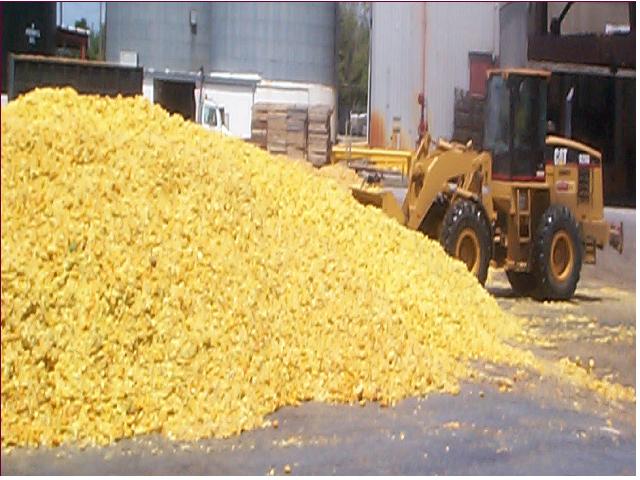

Orange Peel Waste being used to make Ethanol
Photo Source:  The Sietch Blog
 Callaway then shed light on how to exploit the essential oils inside the peel and pulp that are natural antimicrobials. Collaborations with researchers Steven Ricke and Philip Crandall at the University of Arkansas in Fayetteville also have identified specific essential oils that kill the pathogenic bacteria.

From the time Callaway began studying citrus as an animal gut cleanser, he recognized that citrus peel can be heavy and expensive to ship long distances, so his latest studies have investigated the use of processed orange peel pellets.

For one study, the team fed dried orange peel pellets to sheep as a model for cows for eight days. They found a tenfold reduction in Salmonella populations in the animals' intestinal contents. Callaway received a grant from the National Cattleman's Beef Association (Beef Checkoff funds) to help fund the study. Results from the 2011 study were published in Foodborne Pathogens and Disease."

Link to Drovers Cattle Network Source Article: USDA scientists reduce pathogens in cattle with orange peels ; USDA - Updated: November 15, 2011

Thursday, September 29, 2011

A Precocious Newborn British White Heifer


J.West's Lillie Bell and her Carter sired heifer, Sept. 2011
I'm really loving my September born calves, the nice weather change is easier on both the dams and the calves, and because it's no longer hot as Hades even in the evenings, we can sit outside and watch the little ones scamper around and head butt one another and generally feel good to be alive. 

But I've got one newborn heifer that is behaving rather oddly.  Up until this morning,  I was blaming this on her first calf heifer dam, J.West's Lillie Bell - thinking Lillie Bell was just not paying enough attention to her little heifer, not giving her the right moo of instructions to keep up with the herd or something.  Lillie Bell's heifer was born on Monday evening, the 26th, and on Wednesday morning the pretty little thing was all by herself snuggled up in goat weed along a cross fence about 50 feet off of U.S. Highway 69.  That morning I moved her several feet away from the cross fence, as I've had them sort of roll over and under and get up and find themselves in the wrong pasture in the past.


Lillie Bell's Heifer Calf - Very nice, notice how wide she is......
 Later on in the day something made me jump up and head out to check on her again.  Guess where the little heifer was?  She was on the shoulder of the highway with her pretty little head peering through the barbed wire back toward home.  Fortunately, she is very calm and I just lifted one of her front legs over the wire and then the other, and of course she full well knew what to do to go through the fence after that.  Afterwards, she just about flat refused to get off the fence line and walk with me on up the hill where most of the herd were gathered under a grove of hickory trees.  I finally gave up and carried her the majority of the way, a good 250 feet by my estimation. 

This heifer had a chest tape of 27 inches, which translates to a birth weight of about 64 lbs.  I didn't take a live weight on her, I've been trying to be a little kinder to my back lately.  I now wish I'd have done so, as I can't imagine that I could actually carry 64 lbs that far, and uphill as well.  Granted it was hard and I had to stop once and rest myself, but that's a lot of awkward weight to carry.  Sometimes in particularly thick or chunky built newborns, a chest measure can overstate birth weight.

This morning I went out to check the herd, and of course the little heifer was curled up napping right on the fence line of the highway.  I really couldn't believe my eyes.  She is going on 4 days old, her dam has had 4 days to learn a little something about keeping up with her kiddo, yet here she was all by herself in that dangerous spot.  However, this time her dam came down the hill when she saw me with her calf.


Lillie Bell's Heifer Contemplating Crossing the Fence.......
 Lillie Bell came straight away and somehow I think the tone of her mooing was one of absolute irritation with her baby, as in "Why don't you mind me!".  I had my camera this morning and shot some footage of them both.  In the video you'll see the little heifer giving some serious consideration to going through the fence yet again, rather than following her dam back up the hill.  So I'll not blame Lillie Bell any more, as it appears her daughter is just refusing to do as she's told.

The heifer calf was sired by J.West's S.S. Carter, and Lillie Bell is an El Presidente daughter from an Elvis sired daughter.

Sunday, March 7, 2010

In March 2009, a Bill was Introduced to Prevent the EPA from assessing a "Cow Tax"

The efforts of South Dakota's Thune to protect the farmer from a "cow tax" on methane emissions from the cow's belch has not resulted in actual passage of a bill specific to prohibiting a "cow tax".  However, a prohibition against such a tax is included in a 2010 appropriations bill.  While the "2010 Interior and Environment Appropriations Bill prohibits the Environmental Protection Agency (EPA) from taxing producers for naturally occurring livestock emissions,"  -- the battle is far from over.  

The current cap and trade legislation includes the "dietary modification" policy recommendation of the United Nations, and the EPA continues to maintain numerous web pages devoted to the methane emissions from the cow's belch.   

This anti "Cow Tax" bill, introduced right at a year ago, is sitting in the Committee on Environment and Public Works, per govtrack.us.  Voice your support of this bill at WashingtonWatch.com.  The minority voice of Vegan Meat Haters would appear to be the vast 'majority' of any concerned US citizens who have taken the time to 'click' their opposition to this bill --take the time to voice your support, the risk to the family farm is quite real.


Thune, Schumer Introduce "Cow Tax" Prevention Bill, Puts Nail In Coffin Of Inane Proposal That Could Cost SD Farmers An Estimated $367 Million And Put Family Farms At Risk Of Going Out Of Business


Financial Impact Would Be Devastating To The Thousands Of Family-Owned Farms in South Dakota
"March 5th, 2009 - Washington, D.C. - U.S. Senators John Thune and Charles E. Schumer (D-NY) today introduced a bill (S.527) that will once and for all prevent the government from imposing an onerous "cow tax" on farmers across the country. Late last year, the Environmental Protection Agency (EPA) discussed regulating greenhouse gases in its Advanced Notice of Proposed Rulemaking under the 1990 amendments to the Clean Air Act, which could include requiring farmers to purchase expensive permits. Although the EPA did not propose moving forward with the permits, Thune and Schumer are taking preventive action to protect America's farmers. The "tax" would cost South Dakota farmers an estimated $367 million -- or $175 per dairy cow, $87.50 per beef cow, and $20 per hog -- fees that could put already struggling family farms on the brink of closure.

In a move to alleviate farmers' fears and ensure that such a proposal is never implemented, Thune and Schumer introduced legislation to prevent the EPA or any other governmental agency from imposing this fee on farmers.

"The Clean Air Act was written to curb pollution from smokestack industries, not to regulate livestock production in South Dakota or elsewhere," said Thune. "Livestock producers do not need another burdensome regulation to worry about, and this legislation would ensure that the `cow tax' never becomes a reality.

"Cattle and dairy production is vital to the economy of South Dakota and to our nation, and in these difficult economic times, it would be disastrous to enact policies that would increase food prices for all Americans. This bipartisan effort reflects our commitment to ensure overbearing proposed rules are never put in place."

"Times are hard for families across New York State, and they are particularly hard for our farmers. The idea of a imposing a cow tax on our farmers and adding one more crushing burden is absurd," Schumer said. "This bill will put an end to this inane `cow tax' once and for all."

In 2007, the Supreme Court ruled in Massachusetts, et al v EPA that the EPA cannot categorically refuse to regulate greenhouse-gas emissions under the Clean Air Act, a law that defines EPA's responsibilities for protecting and improving the nation's air quality. On July 30, 2008, in response to this, the EPA began to consider the implications of defining greenhouse gases as an air pollutant by issuing an Advance Notice of Proposed Rulemaking. This is typically a precursor to a proposed rule and the first in several steps in creating a new regulation. As a part of this process, the U.S. Department of Agriculture (USDA) responded to the Notice with a comment that defining greenhouse gases as air pollution may require the EPA to issue permits to farmers for their livestock. Currently, permits for other pollutants cost roughly $45 per ton, though that level can change. Title V of the Clean Air Act requires that permits be obtained by most large and small sources of air pollution.

The USDA indicated that if the EPA chose to move forward with regulating farm animals and requiring permits for emitters of methane, farms with more than 25 dairy cows or 50 beef cattle would need to purchase permits for each ton of methane their animals emitted. The American Farm Bureau Federation, assuming a price of approximately $45 per ton, calculated that this would cost $175 per dairy cow, $87.50 per beef cow, or $20 per hog. This regulation would cost a medium sized dairy farm with 75 to 125 cows between $13,000 and $22,000 a year. It would cost a medium size cattle farm with 200 to 300 cows between $17,000 and $27,000.

If enacted, these permits would be devastating to farmers and could put family farms at risk of going out of business. Beef and dairy products are part of a highly competitive global market, meaning American farmers cannot significantly raise prices when the cost of doing business in the United States rises. If forced to pay a "cow tax" or other additional fees, farmers could face a competitive disadvantage, which could close farms and lead to more imported food products.

Importation of dairy and beef products carries its own set of risks for consumers. Overseas livestock and dairy farms are often not regulated as stringently as U.S. farms, and cases of tainted agricultural and food products making their way into U.S. markets have proliferated in the last year. Most recently, baby formula in China containing dangerous levels of melamine and a salmonella outbreak resulting from contaminated jalape¤os from Mexico have rocked American consumers and put the U.S. imported food safety apparatus to the test.

South Dakota is in the heart of farm and ranch country and is a leading producer of livestock. South Dakota has 15,700 cattle ranches, 660 dairy operations, and 960 hog operations. With this new livestock fee, South Dakota farmers and ranchers would pay approximately $367 million in new fees each year to continue operating at current levels. The livestock sector break down for South Dakota is as follows:
  • There are 3.7 million beef cattle in the state of South Dakota, which would result in $323,750,000 in fees for South Dakota farmers
  • There are 1.42 million hogs in the state of South Dakota, which would result in $28,400,000 in fees for South Dakota hog farmers.
  • There are 85,000 dairy cows in the state of South Dakota, which would result in $14,875,000 in fees for South Dakota dairy farmers.
To ensure the burden of a cow tax is never placed on South Dakota farmers, Thune introduced a bill that will prevent the government from imposing the fee, by ensuring that Title V of the clean air act will not apply to methane emissions from livestock agriculture."

Wednesday, February 24, 2010

Climate Change in Texas - Our Texas Cows Got the Message . . .

. . . and the East Texas cattle population has formed an alliance to suppress belching and farting in the interests of  protecting the Ozone -- apparently it worked.

The weather in Texas is notorious for being unpredictable within most any season, and in this upper sliver of southeast Texas, tucked right in the northern edge of Tyler County -- this winter has surely been one to remember.  I'd say the cows have done a pretty good job of holding back on those belches, maybe the constant hole digging in the soil by the bulls isn't 'soil degradation', but is actually a repository for herd belches. 

Yesterday evening the snow and sleet started about 5:30 PM, and it was pretty nasty outside.  But within an hour it was just pretty flakes of snow falling. By 11:00 PM the pastures and the treetrops were covered in a white blanket of snow, and the flakes were still thick and softly falling.  This morning the melt had already begun by the time I took a few pictures, but as we will be in the throes of man and cow caused Global Warming within a few short years, decades . . . who knows what the current time line theory is-- I certainly recorded what may be never ever seen again in these Pineywoods.

Last night's snow fall has been our third snow of the winter, and the same can be said for many other parts of Texas as well.  Yet Texas is the cow home of the largest population of cattle in the United States of America, over 13 million head of cattle.  The atmosphere above the blue skies of the State of Texas must be surely choking on methane emissions from the belches of cows and from their manure. 

Is there a Texas sized hole lurking in the ozone above our great State?  I haven't heard about one.  And the air I breathe in my rural part of Texas is clean and fresh.  The same can not be said about the City of Houston.  If there's ever a time when I remember the fast driving fun of my youth, it's when I'm trying to get the heck out of Houston so I can breathe again and leave my constant Houston Headache behind  -- and get back to my rural country air filled with the cow belches just as fast as I can.

We are told that cattle are a greater contributor to Global Warming than the Transportation sector.  A trip to Houston and back to home always shows what a Farce that notion is.  This third snowfall as well shows what a farce that notion is.  Texas farm and ranch land accounts for some 78% of the total land area in the State of Texas, or about 130 Million acres.  Eighty-three percent of that farm and ranch land is in the hands of small land owners having less than 499 acres, and a lot of cows roam that acreage.

Per the Texas Dept. of Agriculture (2007), "Texas is the number one cattle producing state in the country, with an inventory of 13.8 million cattle and calves -- more than twice as many as the next largest producer."  Shouldn't we Texans have hole in the ozone to worry about? Shouldn't we be in a sweat instead of a shiver?  Or have our cows found a way to circumvent the goals of the EPA, the United Nations, and their great and all powerful leader -- the Intergovernmental Panel on Climate Change?

Visit my HubPage for an in-depth examination of the EPA and FAO efforts to exert governmental control over the cows in your pastures at a level you could never have imagined in a rational world.  (Image below is provided by your EPA to assist you in understanding just how to test the methane of your cows - looks like a bad, very bad joke.)

Monday, January 18, 2010

An Interesting Bit of History on Truly Freezing Weather in Southeast Texas

How Galveston's Frozen Point got its name
Bitter cold conjures up memories of 1895
By SHANNON TOMPKINS Copyright 2010 Houston Chronicle
Jan. 16, 2010, 9:01PM  

Excerpts Follow, Please Click Here or the Blog Title Link for the Full article.

It was blasted cold for southeast Texas this past Saturday morning — 22 degrees according to the truck's thermometer — and ice coated the surface of ditches bracketing the gravel road carved through the marsh on the north side of East Galveston Bay.

My mind wandered as I watched a handful of ducks bore low over the flat, winter-browned landscape, looking for some patch of unfrozen water into which they could pitch and settle. I imagined the swarms of waterfowl I'd have seen had I been at this spot 115 years ago.


“Reaching East Bay, they saw dead cattle lying so thick in the shallow waters along the shore that a man could walk for several hundred yards out into the Bay on the bodies of the dead cattle.

“There was a point of land extending out into the Bay where most of the cattle made their last stand before stepping off into the water to their death.

“From that day forward this point of land was known as Frozen Point.”
If they only knew ...

shannon.tompkins@chron.com