Showing posts with label White cattle. Show all posts

Wednesday, August 15, 2012

Ancient Kuri Cattle of West Africa & and the Park Color Pattern


This quite powerful and stunning image made me gasp and my jaw dropped with a stunned 'OMG'.  It was kindly sent to me by Andrew West of Cornwall, England.  Andrew tells me in regard to the caption for this image ". . . roughly translated it says they are `Gehornte Kuri-Rinder from the Buduma Area of West Africa`.


Kuri-Rinder from the Buduma Area of West Africa

If ever there was a photo or painting that made one immediately think of the kinship between the ancient auroch and both the polled and horned white Park cattle of today - this one would be it.  The distinct color pattern - which is commonly referred to as the Park color pattern by geneticists today - is a color pattern found across the world in highly distinguished breeds of great antiquity and tradition.  The Kuri is clearly another such breed, and I am pleased to have had it brought to my attention.

These Kuri Cattle have a quite mild demeanor (they are used for both milking and beef) about them in the image above and look to be moderate in size.  The average birth weight of Kuri calves is just over 50 pounds, with the females weighing about 950 lbs. Their horns are reminiscent of the depictions of the skeletal remains of aurochs.  Note the very large diameter of the base of the horns in this skeletal image.

Aurochs bull at the Zoological Museum in Copenhagen from 7400 BC

"Kuri
 cattle are predominantly white although various colours are often present. Kuri owners seem to have a general preference for white breeding bulls. The distinguishing characteristic of the Kuri breed is its horns: they are immense, consisting of a lightweight fibrous material with a spongy interior and a very thin external shell."  (The unique Kuri cattle of Lake Chad BasinNtombizakhe Mpofu and J.E.O. Rege,  2002)
Today the predominant cattle type in Africa is Zebu based, or bos indicus. But -- it is widely held that the indigenous cattle of Africa were bos taurus.  DNA studies of a wide variety of cattle breeds in Africa, including the Zuri, confirm that the Zuri is in fact of bos taurus descent.
"African cattle are believed, from prehistoric artistic representations, to have been Bos taurus (taurine) in morphology. . . The indicine (bos indicus) allele was observed in all West African breeds (including taurine breeds like the N’DamaMuturu, Somba, Kapsiki and Namchi) except the Kuri and shorthorn Lagune breeds." ( Mpofu & Rege, 2002)
The Zuri apparently have a unique adaptation to their native hot and humid environment.  They are excellent swimmers and often are led across portions of the waterways of Lake Chad by their herdsmen to reach new grazing areas, even grazing in water to eat fresh grass or sea grass, that tops the surface.  Their horns, while being massive and distinctive, are actually quite light in weight and thought to be an adaptation to their native environment of many thousands of years.
"Although the horns are generally very light, approximately 1% of Kuri cattle have such heavy horns that their heads are, to some extent, tipped up by the weight. It has been suggested that, by tipping back the head, the weight of the horns keeps the nostrils out of the water when swimming. The bulbous base and spongy interior of Kuri horns are assumed to be an adaptation to aid buoyancy when swimming. Some selection within the Kuri has resulted in other horn shapes such as lyre- or crescent-shaped horns."   ( Mpofu & Rege, 2002)
"In the dry season, the animals follow their herdsmen in swimming through the waters from island to island in search of waterweeds as feed . . . There are tribes who move their cattle to upland areas during the peak of the wet season and return them to the lowlands in the dry season . . . Animals are generally divided into transhumant and non-transhumant herds. The latter are comprised of lactating cows (and their calves) which are left to provide milk to the children and older people who stay behind to fish and farm. Transhumance is, however, limited to the environs of the lake, probably because of the susceptibility of the Kuri to sunlight and heat and its limited ability to trek long distances."  ( Mpofu & Rege, 2002)

I've read lots and lots of old articles from the early to mid 19th century and beyond that debated the notion, or myth, that the horned white Park cattle (primarily the Chillingham herd) that roamed the British Isles were actually some how a singularly pure and direct descendant of the 'auroch' race -- aurochs being the original truly wild and very large beasts that inhabited Europe, Asia, and Africa.   That old myth has been well debunked in the 21st century.  Even so, the color pattern was clearly present in both the European and African auroch.

The Zuri quite beautifully exhibit the Park color pattern, and particularly the recessive red that was the subject of the greatest portion of the first recorded European oral and written histories that reference both the milk-white polled and horned examples of white cattle bearing the Park color pattern.
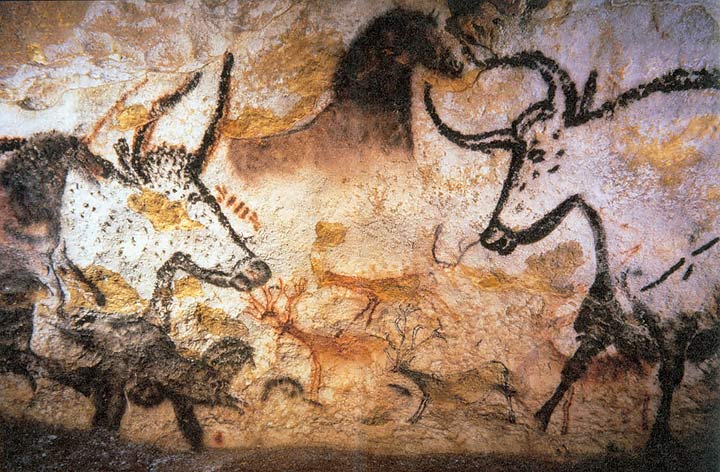

Cave Painting in Lascaux ,France - c. 15,000 B.C.
I've run across representations of cave paintings over the years that included illustrations of white beasts, speckled beasts, and black ones with a white line down their back - which, as discussed in a February blog, has long been known as the Riggit pattern.  What I never realized is those cave paintings are considered to be drawings of the auroch - so I deserve quite a thump on the head for missing that!


Cave Painting in Lascaux, France
You can see in this first photo that the aurochs represented in this French cave painting are white, with darker noses, and actually speckled as well.  And this next one also shows a white speckled auroch, along with a horse and some other type of small animals which are portrayed as brownish in color.  The ears and nose are distinguished as a different color in both drawings, and in the first drawing you can see that the legs are dark - quite like both the horned and polled Park cattle of today.


In 2010 it was reported that an experiment had commenced to attempt to re-create an auroch from breedings amongst those modern day domestic breeds considered to be most representative of the auroch.  In this article from The Telegraph we are told that the Highland of Britain and the ". . . white Maremma breed from Italy," are two of the breeds being used in this experimental "back-breeding".  If you do a web search for images of the Maremma breed, you get results with both white examples and grey examples of this breed, also two different spellings:  Maremma and Maremmana .  Here is a photo of a "white Maremmana" . . . 


Maremmana Cattle
White Maremmana - by Amenon on Flickr

The inclusion of the white Maremma in this experiment certainly indicates that the scientific community considers the Park color pattern to be one of great antiquity that indeed was found in the indigenous aurochs of prehistoric times.  But then, I would think that most every basic, or root, coloration of modern day domestic cattle would track back to ancestral aurochs . . . What I find sad, inexplicable, and irritating is that clearly the milk white auroch of prehistoric times --  as well as the milk white cow of modern recorded history  -- were both highly revered back in days long long gone . . . NOW, they are generally found undesirable here in the USA by the commercial cattle industry . . .  thanks in large part to the promotional success of Certified Angus Beef  and the dominating USA demand for black hided cattle.

The future of British White Cattle continues to be in the hands of largely hobby farmers in the USA.  Their owners are captivated by their beauty and uniquely gentle natures, and of course the quality of the beef.  If you would like to help promote greater awareness and acceptance of polled British White Cattle in the mainstream cattle industry  - visit  the United Kingdom's British White Cattle Society web site for additional information.
Lascaux Cave Painting, France


Thursday, February 11, 2010

British White Cattle - Selection and Breeding for Color Pattern

Many thanks to Diamond C British Whites in Smithville, Texas for these photos of her Tom Sawyer sired calves. The first photo shows a newly born bull calf from this past week, having a very nice low birth weight of 64 lbs, with his sister, Diamond C's Taffy, relaxing beside him.  Taffy is about 2.5 months old in the photos.  Both calves are well marked and well made youngsters.  (Visit Lazy A Ranches for a series of charming photos of their Tom Sawyer sired heifer.)

Among British White breeders there are some who perceive a 'perfect' marked British White as one that is a pretty white one with black points and as few spots as possible.  However, historically, as in for several hundred actual years, there has always been varying degrees of speckling and spots about the neck and body in the herds of England of our quite ancient polled 'Park' breed. Even today many of the most revered British White bulls of England exhibit those very traits.

What we all strive to over come is the appearance of the line-backed markings, which are clearly 'over-marked' calves as defined by our breed standards.  Eight or so years ago, when I bought my first British Whites, I was unaware of any prevalence of over-marked calves occurring, or of a stigma attaching itself to the dam, or sire, of those over-marked calves.  I even sold one over-marked bull calf into a starter seedstock herd in my ignorance.  The bull was bought at the side of his dam and was registered, and actually did a fair job of producing nicely marked calves.

Of course, in the beginning, I largely fell hard for the breed's storied history and unique beauty, and bought what I found available to put in my pastures, without any actual knowledge of what I should be asking or looking for in judging the cattle I purchased.  I was quite fortunate to get some really nice foundation animals to start my British White herd.  However, had I been so very judgemental and critical, I would have not have purchased what became significant females in my herd, such as CRae 215G, who had scurs, but was in all other traits an outstanding female; or HRH Bountiful, who is quite spotted, and has had two over-marked calves, one before I purchased her, and another sired by DFTX Watson.  Regardless, I wouldn't think of letting her leave my pastures.  I've no doubt that the two over-marked calves resulted from her genetics, but in a rare breed such as British White, I certainly can live with that.  (Note the linebacked calf in the British White Cattle Society photo below, and the strongly spotted and handsome English bull in their photo above.) 

Today, I find that buyers are much more informed and particular than myself when they approach the decision of choosing the British White breed and in the selection of their seedstock herd.  As well, I am more informed and try to take great care in providing a buyer with all the information of consequence that may impact their buying decision; whether it be scurs present in a cow, an over-marked parent, or an unruly nature.  Eight years ago, I had no idea what a scur was, or that it was undesirable.  I'll never forget my young niece, she was about 11 years old then and my pasture buddy whenever she could come and visit, gleefully pointing out to me all the cows in my herd that had scurs, she was quite proud of herself, and she was remarkably dead-on in her assessment.

I've no idea why now some aspects of our breed are more focused upon than eight years ago, perhaps the breed has made greater strides in the last ten years versus the thirty breeding years in the USA that preceded.  Regardless, this new focus on 'perfect' and zero spot markings is perhaps leading to the dreaded 'single-trait' selection that over time leads to breeding and buying decisions that introduce undesirable traits as to conformation of individual animals, and may as well lead to under-marked animals, such as occurred in the ancient horned Chillingham herd at different points in its storied history.

On the other hand, the education and focus of breeders on rooting out scurs is one that should be addressed; and in fact in England a scurred animal is not permitted registration under the breed standards of their British White Cattle Society.  As scurs are fairly commonplace in our American herds of British White cattle, the eradication of scurs from registered animals would certainly require a structured approach and goodly period of time. 

As well, the Society began a structured closure of their breed-up program in 1996, in order to ". . .further continue the process of ensuring that the British White remains true to the type that has graced our countryside for centuries."  This very topic comes up from time to time among our members, but is generally tabled as just not the right time.

**********

The most recent English semen imported to the USA was that of Huckleberry Finn.  Huck Finn has lots of spots, and I don't recall anyone being terribly concerned about that in the odious ordeal most sustained in finally acquiring semen on this English bull.  Use of his semen has declined a great deal as there is a perception that he will mostly give you over-marked calves.  However, only one over-marked Huck Finn calf was ever born in my herd; and the fault lay equally with the dam -- one of my original foundation heifers of standard markings.  But, the tendency for Huck Finn to throw over-marked calves is certainly present in his genetics, as I learned in England that his dam was in fact an over-marked pedgiree English female.

That said, generally an over-marked animal is the result of a 'nicking' of similar genetics with the female he is mated with.  Probably one of the single most important questions breeders should ask about animals they are considering purchasing, is whether the animal has any overmarked females in at least the prior four generations, on either the dam or sire side.  Relatively new breeders such as myself would not be able to answer that question, as it is not revealed on registration pedigrees; and I breed just as blindly as everyone else with my older females.  This information would require a call to the BWCAA and a look up of individual animal records.

If you're really interested in trying to understand why within the British White breed there are speckled, roaned, and line-backed animals born to standard marked parents -- I recommend a close reading of the in-depth research on the genetics of color presented by the Double Helix ranch, a prominent breeder of Texas Longhorns.  The English Longhorn and the horned White Park were inter-bred in their long history -- the horns of the Longhorn leaving their mark on many examples of the horned White Park today, and the color pattern of the horned White Park leaving its mark on the English and the Texas Longhorn today.


  Moorside Black Knight, Sire of Hevingham Polaris, Gr. Grandsire of Tom Sawyer
Hevingham Polaris, Awesome Sire of Huckleberry Finn, Grandsire of J.West's Tom Sawyer, Follow this link for a photo of an aged Polaris at pasture, note he is blue-skinned and does have speckling.
 
De Beauvoir's Huckleberry Finn, Sire of J.West's Tom Sawyer


J.West's Tom Sawyer
  
J.West's Zeus, Son of Tom Sawyer, Maternal Grandson and Paternal Gr. Grandson of Popeye
  
Lazy A's Little Beauty, Daughter of Tom Sawyer, Maternal Granddaughter and Paternal Gr. Granddaughter of Popeye

(For a nice selection of photos of examples of British White cows and bulls in some of the herds of England, visit this Bohaty's British White page.)