Showing posts with label Southeast Texas. Show all posts

Tuesday, January 15, 2013

Our Christmas Miracle - A Thankful British White Heifer

Meet this gutsy little heifer who controlled our daily lives for several weeks, starting the week before Thanksgiving and continuing on through the New Year.  Her name is now Thankful, and she is grateful for our efforts I'm sure, but Holiday might be a good moniker for her as well, as she certainly took over our holiday season from Thanksgiving to the New Year!  Thankful hung her rear legs in a hay ring in surely the most awkward and puzzling way I could ever have imagined.  It was one of those sturdy green ones from Tractor Supply, certainly doesn't look like a potential death trap to yearlings . . . but strange things happen around here!


It was almost a full two days after her injury before she would eat or drink.  Cows have such endurance and tolerance for pain, even the yearlings, it's hard to say whether she wouldn't eat because she was in silent pain, or she was super ticked off at not being able to walk and she was purely sulled -- most likely a bit of both I'm sure.  My miracle cure to perk up Thankful's appetite was a big syringe of pure Louisiana cane syrup that first night, and she was eating finally by the end of the next day, and perhaps more importantly, she would finally drink.


The picture above is in the first week of her injury.  You can see one of two different splints we tried on her right rear leg . . . hard to say whether either attempt was helpful to her, but it did stop her from trying to crawl on a flipped backward ankle and perhaps creating more damage.  We weren't even clear on just what was wrong with either leg, but the right rear weakness seemed to be her hip at issue as she had full retraction in the leg.  It wasn't until about the 2nd week or so in to the injury that her hair started slipping on the left leg and I realized it was an oozing infectious mess underneath her skin to be sure.  The circulation was cut off to both legs trapped in the ring, her limbs were cold and hard when we found her that morning, and I'm guessing maybe it just like killed the skin?  Just don't know.  The vet didn't even notice it when he was here after Thanksgiving, otherwise I'd likely feel guilty for missing that damage so long.


My choice of bandages . . . duct tape, and lots of it, over big gauze pads, it worked pretty good if you wrapped the top and bottom several times.  I finally had to actually trim away a large section of her dead hairless hide . . . I suppose I was looking at raw muscle under there.  I had no idea how all that was going to play out and tried real hard not to let my imagination get away from me there.  And, no, I did not call the vet again.  When he saw her the first week he only gave her at best a 20% chance of a full functioning recovery . . . if he saw that mass of exposed red meat I was doubtful he'd leave me with that 20% of hope I was working with.


During that first week she started managing to move about the pasture in sort of a crawling-hop, and mostly she managed to move about in a downhill least-resistance direction.  So by the morning of Thanksgiving Day she had landed right up next to a big woodpile at the bottom of the slope and we knew we'd have to find a way to move her away from there. Given her bad luck the whole pile might just come tumbling down on her if she tried to maneuver herself around about the woodpile.

After a lot of arguments and ideas, we finally settled on using the hay tarp straps to cinch Thankful up and pick her up with the hay forks to move her to a safer place. Mike as always was as willing and determined to get the job done as ever when we have a man-sized dilemma with the cows.  Normally, I say something not very nice under my breath when I encounter one of his knots on something about the place that I have to deal with -- this time I was happy in knowing he would tie some really good knots in those tarp straps to hold her in for her tractor ride.


We were able to move Thankful about 100 feet towards the edge of this pasture, and likely that's as far as this method of moving a heifer is good for because of the body compression from the straps.  Mike also kept the tractor moving very slow to keep any stress on her over the bumps and hollows of the pasture to a minimum.  Thankful didn't seem bothered by her adventure, she never got agitated at all, and just seemed to think it was all part of this new strange chapter in her life.  You see her below just after we got her settled in along the pond fence with hay and water, and if you zoom in on this photo you'll see some creative hay string at work to repair the fence . . . life on a hay string  . . . it's not so bad!


Over the days that followed Thankful began to move mysteriously about during the night, and we'd find her greater and greater distances from where she'd been fed the night before. Curiously, she kept herself going around the perimeter of the pasture, following the fence line, until she'd reached all the way to the top end of it, saying hello! to all the traffic on US 69.  At this point she'd been travelling up hill for some days -- and then she started back down and around - she seemed to have a travelling plan and she wasn't going to let any grass grow under her feet if she could help it.  Did I mention she is a very gutsy little heifer? 

This went on for some weeks and Christmas arrived and we clearly weren't going to be going anywhere as Thankful still depended on us to bring her hay and water where ever she landed.  About a week before I'd managed to get her moved from the pasture she was injured in to the next one and on from there to a trap  area that would contain her to smaller digs.  It took some grit from both of us to do that, she could only move a short distance at a time, then she'd rest, then I'd prod her to get back up and I'd help support her weight on her right rear side as she hobbled a ways and then gave out and rested.  We eventually made it to our destination, and we both were well pooped out.

We spent Christmas here at home, which is always fine with me, but it turned out to be one of those you don't want to ever recall so you just block it out and go on down the road.  A runaway freight train rather than Santa Claus actually arrived on the Eve of Christmas here on this beautiful hill in the Pineywoods we call home, and seeing the arrival of the break of day on Christmas morning was a blessing.  But even more of a blessing was discovering that Thankful suddenly had found the use of her right rear leg.  I will always believe that it was the gift of a miracle for both of us, a sign of hope for the future.

Below you'll see a video of Thankful on New Year's Eve. It took some days for my brain to believe what what my eyes had been telling me since the day after Christmas, days to even say to Mr. Brown, my very special right hand man who helps me here, look at her, can't you see! she's better!  Like me, he had shaken his head and given up on her to make any more progress just a couple weeks before.  But also like me, once he really looked, he saw it too, and I knew it wasn't just me being hopeful or too positive, or any of that.  She was really better, much better!   

Here is a video of Thankful on New Year's Eve, and pardon the music, but I thought she deserved all that clapping . . .


The video below is of Thankful just 3 days before Christmas.  I took this video to send to my vet to show him she was NOT progressing and to see if he still was agreeable to taking her to his place and then harvesting her for beef . . . ouch.  Some of you may think that is really awful, but in fact it was to my mind the most humane way to deal with her if she wouldn't recover well enough to carry a calf.  I certainly wouldn't have wanted to take her to a sale barn or try to find someone to put a bullet in her head and then ask Mike to please honey bury her.


Thankful continues to get better and better.  She was running and cavorting with this cold weather today, and I saw her literally hop up and down with both rear legs in sync!  She shows every indication that she will make a full recovery.  My vet did add when he gave me that 20% of hope for her all those weeks ago . . . that it didn't perhaps apply to me as I lived things longer than anyone he new . . . a reference I'd imagine, didn't ask, to my old and beloved Fred, who came to me on a Christmas Eve twenty one years ago . . . we do miss him.

Wishing everyone a happy, healthy, and prosperous 2013!


Saturday, December 15, 2012

A Pair of Champions - British White Steer and His Showman!

British White Steer at 2012 Fort Bend County Fair in Rosenberg, Texas


Grant and British White Steer - Titus - Fort Bend County Fair
September 2012 - Both of these boys are champions. . . .

We all learned recently that the BWCAA board voted to award a monetary premium to kids who show British White animals and win champion in their class.  I have to say I find it a bit of an underwhelming and an ineffectual token effort at supporting or promoting the breed.  The fact is most kids take a huge risk of their time, effort, and money to show a British White heifer or steer.  So far as I'm concerned, these kids who stubbornly stick to their guns with their Ag teachers and parents and 4H advisers who vehemently counsel them NOT to choose a British White -- those kids ought to get an award of financial help from the BWCAA, not just a breed champion winner.  These kids are WINNERS simply by virtue of stepping out of the box and showing a British White animal!

Grant is just such a winner.  Grant took a grassfed steer out of the pasture and turned him in to a beautiful shining example of the breed.  Titus had been long since weaned, probably a good four months, and turned out to winter hay and alfalfa rations.  His counterparts in this steer competition most likely all came from grain backgrounding programs aimed at pushing their growth before they were even off their dams, halter broken at a young age, and made available as show steer possibilities right from the jump.  So that difference in background feeding was an enormous hurdle that Grant and Titus had to overcome and it was quite a challenge.  As for halter breaking - Titus was awesome about that, and Grant was quite happy with the ease of working with him and by all accounts Titus just loved all that attention. 

Titus was an American Fullblood sired by J.West's El Presidente and his dam was J.West's Brigit, a King Cole daughter.  While Titus did not place, the judge couldn't find a criticism to make of him that I could hear - except to say he would be a top contender in the group if he had had 60 more days of finish on him.  The judge did not even acknowledge that Titus was a British White!  Perhaps he did not know.  Hmmm....... Is that lack of breed awareness or respect my and my fellow small breeders' responsibility or fault?  Or is it the Association's lack of support in promoting our breed to the mainstream cattle industry?  If they don't find the cattle worth the monetary risk of supporting and promoting them - who will?

Titus in April 2012 at the School Barn
So far as I know there are no wealthy individual members who can hire a marketing firm for promotion and education or single-handedly orchestrate a steer test or British White show and sale for the benefit of all members and the breed.  And for certain, we small breeders can yak all day long about how awesome we find our British White cattle, put up nice web sites, take good photos, give away meat from our freezers, even practically give away bulls to get someone to try the breed - but that doesn't cut it in the long run because it is not data - real data - on the merits of the breed - and cattle are business - and successful businesses operate on supportable facts - not the fairy dust of words or opinions.  

Below is a video of Grant and Titus' big day at the fair. This was Grant's first effort at raising and showing a steer.  He learned a great deal in the process, and I did as well, as he kept me abreast of the feeding regimen and weight gain as things progressed, as well as shared lots of amusing stories of Titus' good-natured antics.  I was very proud of him and his steer.  Grant didn't get Titus until late in the game, and that no doubt contributed to the lack of finish the judge observed, and I didn't help any by trying to get Titus transitioned to grain from grass a bit too fast.  That was a disaster to say the least, and Titus looked woefully thin and not at all a show contender.  Despite how pathetic Titus looked when Grant picked him up, I think he and I both hung on to the picture of him in our minds of how he was just weeks before and what he could be.    

Youngsters like Grant with a strong passion for the breed who resolve to show them against all odds and advice are the future of this breed - and each one should be applauded and awarded for their efforts.  And no doubt devoted Mom's like Grant's mother, Darlene, would certainly appreciate the acknowledgement of the very special grit and determination of their kids who insist on showing a British White.


Back to this new premium for showing winning registered BWCAA animals - I would also add that most kids will only ever be able to receive the lowest "premium" of $100 that is designated if "breed consists of 1 animal" and they are blue ribbon winners by default, as you will rarely find a show with more than one British White animal.  And further, the fair authorities would have to give you your own breed category!  Of course, if it is one heckuva steer or heifer, perhaps they might when "Champion Other Breeds" - one can always hope.  And also, I noticed it had to be a State Fair.  What's up with that?  Showing starts at the ground up, just like a political race, and it would appear the smaller county fairs that lead up to State Fairs just don't cut the mustard.  Unfathomable....

If the BWCAA can afford to waste about $2K on a useless and wholly unnecessary compilation and review (there is no such thing as a "review audit") and now another $2K? on officer's liability insurance each year - then surely our BWCAA member fees can be allocated a bit more generously to these FEW youngsters across the USA who stubbornly take on the world to show their British White steers and heifers.  


Saturday, July 14, 2012

British White Cattle for Sale in East Texas - Have a look at the Herd


Wow, talk about a drought busting stretch of rain!  It was odd to wake up this morning and realize the sound of thunder or rain on the roof had not woken me up all night - as that has been the norm for a stretch of days lasting almost a week.  Some days it seemed we were in the tropics, it would just gently rain and rain and rain all day.  I can't say for sure, but I think we've had at least 9 inches all together - our newly adopted dog decided to see how the rain guage chewed, so the only measure is from a 5 gallon bucket.  I do hope the rest of the country sees some relief soon from the drought, and maybe finds some hope in the pouring rains of the Texas/Lousiana coast that likewise suffered through drought last summer.

Here's a look at some very impatient British White cows, they had let me know a day or so before that they were somewhat irritated at the conditions in the adjoining pasture and were quite ready to move on - and they moved on in a hurry.  Can't say I blame them, the grass was looking mighty fine on the other side of the fence.

Most all the cow/calf pairs offered for sale are in this group.  If there's a particular cow in the video that catches your eye, give me a call, she may be available as well.


Wednesday, June 27, 2012

Thinking of Sprigging a new Pasture? Harvest Bermuda Sod with a Two-Horse Turning Plow Instead . . .

The health of pasture grasses this season, after the really hot late summer drought we had here, is a constant topic of conversation - even if only in my own mind with my own self.  I've seen lots more weeds this year, and some even look like new varieties to me, and some of the pastures are growing thinner stands of grass than last year.  I've been exploring having the back pasture plowed up and sprigged again with one of the new bermuda grasses.  But Ouch, it costs a lot to do, and I don't know that it can be justified except in a hay farming operation where irrigation is available - unless you are really good at predicting healthy spring and early summer rains.  Otherwise, there's lots of risk your money will go right down a dry drain.

Here's a look at an old-fashioned approach to establishing bermuda grass pastures in 1898 Mississippi. 
"You will find it growing well on the sandy soil of the piny woods, and on the red clay hills and on the black lands of the prairie belt.  Since Bermuda grass very rarely, if ever, matures seed in this latitude, the only safe method to propagate it is by transplanting the roots or the underground stems. This should be done in March.
After the land has been prepared as recommended above, then with a bull-tongue or narrow shovel plow open rows two feet apart. With a short spade shave off sod two inches thick; or, a cheaper and quicker method would be take a two-horse turning plow and set it to run shallow, and turn or edge up the sod.  
The sod can then be hauled in large pieces to the field and there be broken or cut into small pieces and dropped in the drill two feet apart, and covered with a light harrow;or, a better plan would be to go over the field with a heavy roller. This would firm the loose soil around the sod and at the same time level or press down the ridges left by the plow.  If the pieces of sod are entirely covered there will be no harm done - as soon as there is moisture enough in the soil the roots will take hold and the grass make rapid growth. In this climate Bermuda will furnish excellent grazing from the middle of May until the middle of November, and often as late as the middle of December."

From:  Winter and Summer Pasture in Mississippi, 1898, by Edward Read Lloyd

Here's a look at the cows in the back pasture a couple weeks back.  This pasture was once a dedicated hay pasture and received constant commercial fertilizers like clockwork in the growing season for probably 20 years.  It has been the poorest growing pasture for years now, and I have to wonder if it's not because of all that commercial fertilizer.  Cows never grazed the land to give it back more complex natural fertilizer, it just lived on N, P, and K. 


Friday, April 20, 2012

Cattle Are Sentient Creatures - And I wouldn't have it any other way . . .

J.West's Elsie Edna and J.West's Clementine, April 2012
Best Buddies, Born 4 Days Apart


There are times in this cow business when I find myself considering, fleetingly, becoming a vegetarian; when I keenly understand why some folks are so adamantly anti-meat.  Some particular event happens that makes me think a little deeper about the 'feelings' of my cows, or at least some of them.

I then mull over in my mind many of the fairly ridiculous stances of a lot of the extremist PETA types, most of whom no doubt have never stepped in cow manure or certainly never resuscitated a newborn calf -- but yet are emphatic that cows are 'sentient' creatures and therefore shouldn't be eaten.  Which leaves them in a sorry life in a zoo in some perfect future vegan world with zero meat consumption. Wait . . . That's also the FAO arm of the United Nations' long term plan! But I'm not going there this morning, discussing the FAO right now would give me a headache and make me nauseous, and my health care has already gone up 40% in the last two years, so I have to be careful not to go to the doctor, that might be an excuse to raise my rates another 20% next year. Oops, digressing . . .

Elsie Edna and Clementine, April 2012
I recently sent Elsie Edna and Clementine on to their new home in Oklahoma.  These two heifers are really bonded, more often than not found together, and I think would really have been traumatized to have been shipped off to separate pastures.  Eventually that strong tie they have now won't be so important, but at 2 years old the bond is still very strong.  Clearly, these two demonstrate that cattle are indeed 'sentient' creatures, as they have 'feelings' toward one another.

'had' two other heifers who were very much pasture buddies, born 7 days apart - J.West's Boopsie and J.West's Lassie.  Unfortunately, I never took a photo of the two of them together, but I do have a 'picture memory' of the two of them from last Sunday.  They both walked up to the cattle guard by the house, checked it out, looked at me, and presumably listened to me (okay probably not) when I told them not to walk that cattle guard.  But, they did promptly turn around and prance off together . . . and that's the last time I saw them alive and well.

Sunday night we were hit by the worst of thunderstorms and the lightning was very bad.  Boopsie and Lassie died under a grove of hickory trees, lying about a foot apart.  Fortunately, the rest of the cattle in that group were all fine, and so was every other pasture group.  I had moved this group in to the pasture by the house on Sunday so they could get shelter under the barn's big tractor shed, which they generally immediately do when the rain gets hard.  For some unknown reason they didn't this time.  The ground outside the shed was smooth and slicked off from the massive flow of water run-off from the barn roof (we had probably 11 inches or more of rain), so clearly the cows didn't exit the shed after the storm, they simply weren't there.

J.West's Boopsie in August 2011
Boopsie was Carter sired out of a Popeye daughter, bw 66 lbs.
Could it be something wasn't safe that night about the shed?  Oddly, when we finally got power back on Monday, all the power to the barns was still out, and that's never happened before.  Something caused the main breaker to all the barns to trip, and I have to wonder if it was a lightning strike directly to the barns or a hit to the ground around the barns.  They are metal pole barns, with tin roofs and walls of course, and I've not ever considered the possible danger to the cattle from being under a metal structure during severe lightning.  So far we haven't found a thing to indicate a strike on or around the barns, so it will remain a mystery.

J.West's Lassie as a newborn, her dam is J.West's Taylor Maid
Lassie was Carter sired with a bw of 37 lbs.
The sight of those two heifers lying dead and bloated under the hickory grove was a shocking sight.  Their walk to the cattle guard, their quizzical looks at me and down at the rails of the cattle guard, and that quite prancing turn and exit off to the pasture was all I could see in my mind, the contrast startling, the end of that life lying in the mud.  Rational or not, this became one of those moments when I question what I do, and think of the 'sentient' creature argument of vegans against eating meat.

But, even so, as the days have passed and I've thought about my own personal reaction to the loss of the heifers, I suspect it is me being too sentient of a human creature about my cows, or at least about some of them.  Yes, I do think cattle are 'sentient' creatures, many seem to make eye contact with us humans with something ticking in their brains and coming through their eyes that makes a total lie of the 'dumb cow' phrase for sure, could be their eyes are just so pretty I imagine it though.  Look at little Lassie pictured below - she had the sweetest eyes ever.  But sentient creatures or not, beef has been critical to the human diet since time out of mind.

J.West's Lassie, June 2011
So, I'll not be tossing out all the grassfed beef in the freezers, or turning the ranch in to a petting zoo, and for sure I also won't stop caring about the well being of my cows and trying to tune in to what they need in a 'sentient' way.  I'm glad I had that odd last encounter with Boopsie and Lassie; you have to wonder, or at least I have to wonder, about the timing of that and their death mere hours later.  I couldn't tell you one thing about any other cow or calf in that group from the afternoon before - just that picture memory in my brain of Boopsie and Lassie . . .

Yes, cattle are quite the sentient creatures, but I wouldn't have it any other way. 


Saturday, April 7, 2012

Happy Easter from J.West Cattle Company . . . and Happy Spring and Happy Ostera!

Happy Easter to Everyone!

Sandhill Cemetery's Oldest Unmarked Grave, cared for by
Colmesneil's Kenneth Brown, who planted the bluebonnets
 you see on the hillside.   (April 2012)
How fortunate we are that this most ancient and most revered celebration in the Christian world is still allowed to be celebrated publicly in the United States of America.

It actually strikes me as quite odd that it is still politically correct and unoffensive to say 'Happy Easter'.  I really can't imagine why we aren't already forced to say 'Happy Spring' - particularly in our public schools. 

Or has that already happened and I just don't know it?  In the pre-Christian era of the world, those happy heathens, the Anglo Saxons, celebrated spring by feasting to the goddess Ostera - so perhaps we could really trip up those spiritually bereft secularists by saying 'Happy Ostera'!  (FYI - Secularism Definition: ". . . a doctrine that rejects religion and religious considerations.")

Perhaps the day is coming when we see politically unoffensive pagan festivals of the ancient gods and goddesses beneath a peaceful spreading oak tree in a farmer's cow pasture, or  beside the banks of a clear and beautifully flowing stream deep in the woods - all with a closely guarded secret of course - that it's a scam of the Highest Order - if you get my meaning? 

The mainstream media would have a field day with that - probably run massive news coverage with the headline:  Proof The United States is not a Christian Nation! or, Paganism Replacing the Pulpit!  Christian city dwellers could even camp out in the public parks for some pagan tree praying!  Hmmm, what would the media label them?  Occupiers!  Occupying for their right to worship nature . . . what conceivable argument could be found with that?  They would be hailed as 21st Century hippies who actually cleaned up their trash, and would likely be interviewed with fond tolerance on the Today Show or Good Morning America.

Below you'll find some really old sayings and superstitions about Easter that are amusing, but also informative.  I had no idea that getting my 'Easter dress' as a child was from traditions started hundreds of years ago; and certainly had no idea how far back the tradition of the Easter egg dates.  If I'd been asked that question, I'd probably have replied without much thought that it is likely something Americans got started - I've just never really thought about it.  Shame on me. 

Also, I've excerpted at the end a great deal from an 1859 printing of a 'Cyclopedia' on the topic of Easter.  I haven't stopped to check what a modern 'Encyclopedia' says about Easter, I just generally like to read the less politically edited versions of old topics.


Old Sayings that caught my Eye or Ear:

     If you find a little calf on Easter Sunday, keep it and raise it, for it will bring you a small fortune. (Darn, wish I'd known that several years back!  I've only ever had one calve on Easter, and I didn't keep the cow and calf!)

     On Easter Sunday blow a loud horn into the cattle-house, and as far as the sound is heard, so far it will wild beasts keep away for the year.  (Okay, I'm on board for this one, and will be blowing a fog horn through all the pastures!)

     Egg rolling on Easter day used to be practiced with the idea that the farm lands over which the eggs were rolled would be sure to yield abundantly at harvest time.  (I'm too old, not to mention clumsy, to do this one.)

Really old Red Oak Burned up by a Lightening Strike
 a few days ago; fortunately, no cattle were in the pasture - April 2012
     In Catholic times, in England, people used to put out their fires on Easter day and would relight them from a flint. It was thought that a brand from this fire was a sure protection from thunder storms.  (We might need to figure out how to accomplish a modern version of this custom!  Lightening strikes have been many and fierce this spring!)


"At Easter let your clothes be new, Or else be sure, you will it rue."  In many countries it is a very general custom to wear new clothes on Easter Sunday and it is considered bad luck to wear old clothes. In East Yorkshire is the saying, that the birds, especially rooks or "crakes," will spoil the clothes, unless the person wears something new on Easter day.  (I do look back fondly mostly at new dresses for Easter Sunday, mostly, as some of them were awfully stuffy and itchy . . . Note in East Yorkshire you wear new clothes or a bird might poop on you, but in Gloucestershire it was good luck if a bird pooped on your new bonnet!)

     It is lucky to put on a new bonnet on Easter day, and still more lucky if a bird leaves a mark on it. (Gloucestershire, England.)
    
In Devonshire, the maidens rise early on Easter morning to see the dancing sun and in the center of its disk a lamb and a flag.  In Scotland, superstition had it, that the sun even whirled round like a mill-wheel and gave three leaps. This unusual merriment of the sun could be seen in its reflection in a pool or a pail of water, the movement of which of course caused or strengthened the illusion.  An Irish woman declared that she had seen the sun dance for joy on Easter morning: "It gave three skips just as it came over the hill, for I saw it with my own eyes!"  (This is a very old belief, and maybe is the root of the modern day Sunrise Service on Easter?)

On Easter day the water is believed to possess many exceptional properties, peasants ride their horses into the water early in the morning to ward off sickness. Girls wash their faces with the morning dew, to improve their beauty. Water drawn with the stream and while the wind is due east, is supposed to have great healing virtue. Much importance is attached to rain or shine on Easter day:
"A good deal of rain on Easter Day Gives a crop of good grass, but little good hay."
     Who steps not barefoot on the floor on Easter day, will be safe from fever; and if you bathe with cold water on Easter day, you will keep well the whole year.  (I see no reason not to keep this tradition up, and it is so unseasonably hot these days a cold shower shouldn't be a problem at all!)


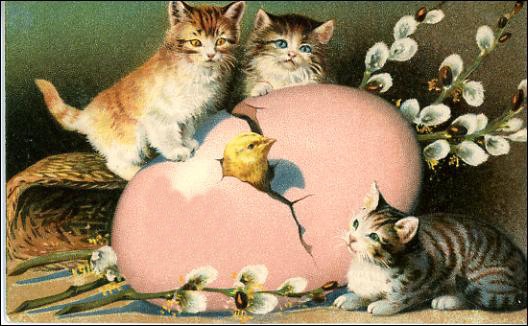
Vintage Easter Greeting Card - Quite Appropriate, and I have lots
of Newborn Kittens to Back that up - Need a Kitty Kat?
On the traditional Easter Egg: 
"The custom of the Christians to present Easter-eggs as a symbol of the resurrection, has been adopted from the peoples of the East, particularly the Persians, where the egg was since the most ancient times symbolical of creation, or the re-creation of Spring. In Christian countries the Easter-eggs were painted red in allusion to the blood of the Redeemer.
The usage of interchanging eggs at Easter has also been referred for its origin to the egg games of the Romans which they celebrated at the time of our Easter, when they ran races in an egg-shaped ring, and the victor received eggs as a prize. These games were instituted in honor of Castor and Pollux who came forth from an egg, deposited by Leda, after Jupiter had visited her in the shape of a swan.
Others allege that the custom was borrowed from the Hebrews who at the passover set on the table two unleavened cakes and two pieces of lamb. To this they added some small fishes because of the leviathan, a hard egg because of the bird Zig, and some meal because of the behemoth.
In some remote districts of France it is still customary for the priest of the parish to go around to each house at Easter and bestow on it his blessing. In return he received eggs, plain and painted.
In Italy an egg dyed scarlet like the cloak of a Roman Cardinal is carried by some for luck all the year round.
It is very unlucky to give away a colored egg that has been presented to you at Easter."

On the history of Easter as presented in 1859: 

Source: THE NEW AMERICAN CYCLOPEDIA: A POPULAR DICTIONARY OF GENERAL KNOWLEDGE, Volume VI., 1859

"EASTER, the festival of the resurrection of our Lord, or the Christian passover. The English name Easter and the German Oitern have been supposed by some writers to be derived from the name of the feast of the Teutonic goddess Ostera (the goddess of spring), which was celebrated by the ancient Saxons in the spring, and for which the early missionaries substituted the Christian festival.

According to Adelung, both the English and the German words are derived from the old Saxon word otter, oaten, which signifies rising, because nature arises anew in the spring. According to the Mosaic law, the passover among the Jews was celebrated on the 14th day of the month Abib, afterward called Nisan, that is, within a day or two before or after the vernal equinox. The early Christians differed in regard to the time of celebrating Easter.

The churches in the West, taught, as they declared, by St. Philip and St. Paul, observed the nearest Sunday to the full moon of Nisan, without taking account of the day on which the passover was celebrated. The Asiatic churches, on the other hand, in accordance as they said with the tradition derived from St. John, followed the Jewish calendar, and adopting the 14th of Nisan as the day of the crucifixion, celebrated the festival of Easter on the 3rd day following, whatever day of the week that might be.

Saving occasional disputes, matters continued in this state until the time of Constantino, who had the subject brought before the council of Nice (A. D. 325). The question was fully discussed, and finally settled for the whole church by adopting the rule which makes Easter day to be always the first Sunday after the full moon which happens upon or next after March 21; and if the full moon happen on a Sunday, Easter day is the Sunday after.

By this arrangement Easter may come as early as March 22, or as late as April 25.—This sacred festival has been termed the queen of festivals; it has been observed from the very beginning, and it is celebrated in every part of the Christian world with great solemnity and devotion. The primitive Christians very early on the morning of Easter saluted each other with the words: " Christ is risen;" to which the response was made : " Christ is risen indeed, and hath appeared to Simon." The Greek church still retains this custom.

In nearly all Christian countries the recurrence of Easter has been celebrated with various ceremonies, popular sports, and superstitions. Among the best known is the English custom of making presents of colored eggs, called pasche or paste eggs, which were often elaborately ornamented ; and in a royal roll of the time of Edward I., preserved in the tower, appears an entry of 18d. for 400 eggs to be used for this purpose.

Colored eggs were used by children at Easter in a sort of game which consists in testing the strength of the egg shells, and this practice is retained in many places in England and the United States. In some parts of Ireland the legend is current that the sun dances in the sky on Easter Sunday morning. This was once a prevailing superstition in England also, which Sir Thomas Browne, the author of "Inquiry into Vulgar Errors," thought it not superfluous to declare unfounded."


For lots of old traditions and superstitions surrounding Easter and other events see:  Encyclopedia of Superstitions, Pg. 1515.

Sunday, January 29, 2012

My Bichon Frise Turned 20 Years Old - Meet my Fred - The Oldest Living 'Confirmed' Bichon Frise in the USA Today!

<> Fred died peacefully in his sleep on Sunday morning, March 25, 2012. He was buried Sunday evening with all the love and grace and honor that such a wonderful life companion deserves.

"We do have another current report of a 20 year old Bichon," and "we have heard of a few that may have reached 20 but their owners never sent confirmation of date of birth.  I suspect those that are supposed to have gone beyond 20 are VERY few and far between." (Feb 1, 2012, Anne at BichonHealth.org)


Forever Fred the Wonder and Pumpkin, Jan. 2012


We managed to escape the ranch for a week on a last minute trip down to Port Mansfield, Texas.  The weather was so mild it was flat hot some days.  Of course we took Fred, my elderly Bichon Frise, along for the trip, and that warm weather seemed to do wonders for his old arthritic bones.  He woke up Christmas morning unable to walk because of some new problem with his right rear leg.  His lower vertebrae are all fused together, a solid mass of bone per the vet.  By the time we got back from Port he was walking good stretches on his own and managing turns as well.  I figured out a way to walk him after Christmas.  I put a leash under him and in front of his rear legs, and support him lightly with both ends of the leash.  It works remarkably well. 

Some of you know Fred from the early days when he was agile and manageable to travel to association meetings and sales.  The past few years that's not been the case, and so I've missed a lot of events out of consideration for my little Fred.  Seems silly to most people, of that I am certain.  But, we do what we do.  Fred turned 20 years old on October 28th, 1991.  I finally contacted the AKC to double check the year of birth, as I'd been thinking he turned 20 last year, but my old memory was off by one Christmas.

Freddie Boy, my 20 year old Bichon Frise, Christmas 2011
Click this link for a video of Fred on Christmas
Fred was a Christmas present for me, and he arrived on Christmas Eve 1991, a bundle of rolly polly joy from the day he arrived, and he loves me madly like I'll never be loved again.  Unfortunately, for quite some time now I rarely get a full nights sleep, or even a stretch of sleep for more than 3 hours, because only his Mom can seem to make him happy and figure out just what it is he needs - food, water, or just me to hold him until he goes back to sleep.  It's not something you think about when you get a pup, that he'll live to be a crotchety old fart that needs constant attention - and believe me it is tiresome and really wearing me down.

Freddie Boy on New Years Day 2012
Click this link for a video from New Years
There are good days for him still, for us all, like New Years Day.  He really enjoyed being outside and just hanging out in the mild weather.  This past summer was so brutal that it was the very rare event that he ever ventured outside, he can't tolerate the heat anymore, or for that matter real cold weather either.  Last September when the weather finally turned mild I brought him outside with me for a while.  I was very happy to see him interested in exploring and sniffing and just enjoying himself out of the house. 

Pumpkin the cat has a thing for Fred, she always likes to say hello to him, tries to get him to interact with her.  It's kind of strange.  Pumpkin gets along with absolutely none of the other cats on the place - once she raised her kittens she was quite done with tolerating them and considers herself very important around here.  This is a video of Fred and Pumpkin in September 2011:


One of these days I'm going to get a scanner so I can scan in some of his old photos - he was quite the cute Bichon pup and the handsome all grown up Bichon as well.  I can't imagine there are very many Bichon Frise's that have made it to 20 years and beyond, so I figure he deserves a little recognition out there for his stubborn survival of 2 decades.

And it really has been a miraculous survival.  He has had so many brushes with death it is mind boggling.  Let's see how many I can recall in order . . .

. . . . . He was deliberately run over by a young punk when he was real young and we were down in Port Mansfield.  He had gotten out of the yard and was standing in the middle of the road and the kid drove straight over him, while I'm running from the yard and screaming my head off at him to stop.  Fred was still standing there after the car passed over him, just fine except for a greasy streak across his back.

. . . . . He was attacked by a vicious and big Cocker Spaniel while he was on a long lead staked out in the front yard at Port.  The dog probably would have killed him were it not for a Labrador retriever named 'Bear' that was Fred's bud from down the street.  Bear heard the ruckus and showed up and attacked the cocker spaniel who ran off with his tail between his legs.  The cocker managed to completely shatter the brand new juvenile cataract in one of Fred's eyes - so it was a pretty rough attack.

. . . . . He jumped off the deck of our fishing cabin and landed in the water instead of the boat he was aiming for.  I was cooking inside and that sixth sense kicked in and I ran outside and there he was paddling for all he was worth in the Laguna Madre - staying like a miracle right there by the boat despite the current that should have carried him away. 

 . . . . . He survived a high speed, high impact rollover accident, along with me, that should have killed us both.  He was literally standing on all four feet after having been tossed through the window on the last roll.  We did lose our Ginger, and Fred howled in grief for her for many years.

. . . . . He fell about 20 feet from a porch to the concrete below and a little bitty BBQ pit broke his fall, and a tooth.  He went in to shock and almost died from that but for a very good vet in Beaumont.  Miraculously he only had a chipped tooth from the fall.

. . . . . He managed to walk the cattle guard and all the way across the front pasture and through the barbed wire fence and into the middle of the highway.  This was early one morning and poor Fred had been forgotten about after being put outside to do his business.  He was saved from sure death by a young family who left their camp on the lake early that Sunday morning to head home in time to go to church.  They stopped and picked him up.  It was a few hours before we found him -- he was at the police station in Woodville having a fried egg with the local cops for breakfast.

. . . . . He was snatched from my doorway by a visiting Rottweiler, literally snatched from where he stood at my feet.  His head was completely in the Rott's mouth and he was being swung back and forth, back and forth.  My Mom saved him from the Rott.  She threw herself on the dog and he dropped Fred.  All Fred had were two slits on either side of his neck that somehow managed to not hit major veins, and the shaking didn't break his neck or hardly even hurt him at all - the vet said he was indeed one lucky dog.

. . . . . He fell that same about 20 feet from the living room floor and straight down, glanced off the bottom stair we think, and hit the floor. We keep the upper stair railings roped off as they are widely spaced, something came undone and we hadn't noticed.  Anyway, Fred the Wonder Dog screamed on that fall, but didn't go into shock, and didn't break any bones or chip any teeth.

Just having problems with his lower back after all these accidents isn't so bad . . .

Forever Fred the Wonder, Born 10-28-91, AKC Registered Bichon Frise
Pictured here at 19 years old in June 2011 -
Lots of Napping may be the key to Longevity!


Friday, January 13, 2012

British White Cattle in Southeast Texas Pastures - Winter of 2012

J.West's Elvis - Having himself a lazy day in the sun . . .
Jan. 11, 2012

Lazy, I've been terribly blog lazy the past few weeks, but it's good to have some things set up and ready to post to give myself a little holiday vacation time from scratching my head about what to talk about.  Today has seen very sunny, cold and windy weather, at least compared to anything recently, and tonight it may well freeze.  I have to think the 18 plus inches of rain we've had the past couple of months, including the 3 and 7/10ths from a couple of days back, will be be of help for all the pasture plants and trees.  Did you know that the safest way for a plant in a pot to endure a freeze is to saturate the pot with water?  It actually helps protect the roots from the cold. 

I'm not sure yet just how many trees we lost in the drought, I'll wait until next spring before declaring anything for sure dead.  So if some hardwood trees that are suffering and still clinging to too many of their leaves (which means they are dead or sick) might just need the protection of wet soil to endure a freeze -- I'm mighty pleased the ground is brim full of water right now.

Limit feeding helps cut down on this sort of behavior as well!
This past summer of drought was a learning experience, but no less so has been this winter.  There have been many articles written over the past few months advising and alerting cattlemen how to manage their herds through a lean winter, and I made some changes in routine following their guidance. 

One I think that has lots of merit is limit feeding hay to your cattle.  Instead of having 24 hour access to the hay, I limit fed for several weeks, letting them in to the hay about 5PM and turning them out mid morning to eat their daily alfalfa on clean pasture.  Afterward, they would mosey around and graze a bit, nap a bit, then by about 4PM they'd begin to gather at the gate to the corral, waiting for me.  I definitely think that helped cut down hay consumption.  The premise is that some cows will just eat and eat and eat if its there, basically getting more than they need, leaving less for others who aren't so greedy. 

The other thing really hammered on by lots of the articles was the importance of adequate nutrition in that last trimester.  We all know they need to be on a good diet leading up to calving, but the problem this winter that the writers were focused on was the 'quality' of the hay being fed.  There is lots of really bad so-called 'hay' out there these days.  Even in my own very fortunate supplies of hay, I realized real quick that lots of it wasn't as good as it had been in the years past. 

So, I brought in Crystalyx mineral tubs again for the first time in a number of years.   The Crystal-Phos tubs are an excellent and reliable product, and it gives you a sense of relief having them out there, particularly through the past several weeks of lots of rain.  A dry loose mineral would have mostly been money down the drain for certain and the cows would have suffered for it I'm sure. 

J.West's El Presidente - Jan. 11 2012
The bulls on the other hand haven't seen much special treatment.  They have red mineral blocks and always the worst hay, but their daily alfalfa ration as well.  They have also begun to graze the pitiful rye grass finally coming on.  Not that I really want them to already!  But, of course I have way too many bulls on the place and they have to call some pasture home around here.  El Presidente doesn't look like he's suffering much, nor Elvis in the photo up top.  We're all getting along just fine for now (knock on wood) . . .

Monday, November 7, 2011

Rain Making in Texas - A Successful Explosives Experiment in 1891

Okay, now this I find quite interesting; it would appear that rain was successfully conjured up in the Midland, Texas area in the fall of 1891.  Also of note is the author's mention of the extent of the drought in the Midland area in 1891 - " . . . little or no rain had fallen the locality for some three years."  It seems the successful experiment was premised on the rains that seemed to consistently fall in the grueling days of the Civil War following the cannon shots and gunfire of major battles.  Hmmm . . . there are a lot of guns in Texas . . . maybe we need to pick a day and time and all shoot at the sky!

SCIENTIFIC. RAIN-MAKING
Otago Witness , Issue 1965, 22 October 1891, Page 45

Article image
Article image
Article image

Article image
Article image
Article image
Article image
Article image


Timaru Herald, Volume LIII, Issue 5269, 21 October 1891, Page 3

Article image


Article image
 
Article image

Sunday, October 16, 2011

Old Sayings and Remedy's - Tyler County, Texas


Payton and Iva Butler Brown in Goose Creek

These are some of the "Old Sayings and Remedy's" of Iva Butler Brown Gray that relate to the weather and raising cattle.   Kenneth Brown, my neighbor and helper here at the ranch, shared these writings of his mother with me this week. 

Iva was born Oct. 13, 1905 in Colmesneil, Texas, and lived to age 95, passing away in 2001.  In April of 1999 she wrote down several pages of old sayings and remedies learned both from her own life experiences, and passed down from her family.  

1)  "The first 12 days after Christmas day are called 'The Old 12 Days' and the kind of weather can be determined by the 12 days representing the next 12 months of the New Year."

2)  "Thunder in February means frost on that day in April (or real cool)."

3)  "Aunt Frankie Gregory (my Mother's sister) always said that between eleven and 2 o'clock you could tell what the weather would do."

4)  "My Grandparents (Allen's) thought March 13th best to plant pepper seed and the 17th of September best day to plant fall turnip seed and start Fall garden."

5)  "Butcher cattle and hogs on the full moon to have good meat to eat."

6)  "Brand cattle on decrease of the moon and the brand won't grow large."

7)  " 'Mark' cattle or hogs when the moon signs are 'in the knees' (1) and they won't bleed but very little."

8)  "Wean calves or children when the signs are 'in the knees'(1), they won't grieve for their mothers or cry much."

9)  "Boil red oak bark or blackberry roots and give the liquid to calves or horses.  This will stop diarrhea in calves or horses."

10)  "For food poison in cattle - Mix 1/2 lb Epsom salts, 1/2 lb soda, 3 Tablespoons ginger, put in bottle, add enough water to make a pint and drench (several times)."

Waxing Crescent Moonshot I took a couple years back. . . .
(1) The moon is "in the knees" when it is in the sign of Capricorn, per the Farmer's Almanac .  "Each day of the month is said to be ruled by one of the twelve signs of the zodiac.  Each sign appears at least once a month for a period of two or three days." (See Hendry County Horticultural News  )   Consult the online Farmer's Almanac current Zodiac Calendar if you'd like to start planting, branding, harvesting, etc... by the daily changes in the planets and the moon.


And Iva finished up her list of sage advice with these two old sayings to live by that most readers will be familiar with:

** "A good name is rather to be chosen than great riches."
** "An ounce of prevention is worth more than a pound of cure."

And I was happy to see two recipes included, one for cake and one for pecan pie -- certainly two staple sweets in the kitchens of bygone days in Southeast Texas.

"This is Grandmother Butler's cake recipe."

2 Eggs
1 Cup Sugar
1 1/2 Cups Flour
1 teaspoon Baking Powder
1 teaspoon Vanilla
1/2 cup Butter (or shortening)
1/2 teaspoon Salt

Bake at 350 degrees until done.
This is a recipe for "Good Pecan Pie", Mrs. Gray doesn't tell us what temperature or how long to cook it, but I'd imagine you can bake it at 350 degrees until done as well.

1 Cup White Corn Syrup
3 Eggs
3/4 Cup Sugar
1 Cup Pecans ("I chop mine")
1 teaspoon Vanilla

 . . . . My thanks to Kenneth Brown for agreeing to let me share these old sayings passed down to him from his mother.

Thursday, September 29, 2011

A Precocious Newborn British White Heifer


J.West's Lillie Bell and her Carter sired heifer, Sept. 2011
I'm really loving my September born calves, the nice weather change is easier on both the dams and the calves, and because it's no longer hot as Hades even in the evenings, we can sit outside and watch the little ones scamper around and head butt one another and generally feel good to be alive. 

But I've got one newborn heifer that is behaving rather oddly.  Up until this morning,  I was blaming this on her first calf heifer dam, J.West's Lillie Bell - thinking Lillie Bell was just not paying enough attention to her little heifer, not giving her the right moo of instructions to keep up with the herd or something.  Lillie Bell's heifer was born on Monday evening, the 26th, and on Wednesday morning the pretty little thing was all by herself snuggled up in goat weed along a cross fence about 50 feet off of U.S. Highway 69.  That morning I moved her several feet away from the cross fence, as I've had them sort of roll over and under and get up and find themselves in the wrong pasture in the past.


Lillie Bell's Heifer Calf - Very nice, notice how wide she is......
 Later on in the day something made me jump up and head out to check on her again.  Guess where the little heifer was?  She was on the shoulder of the highway with her pretty little head peering through the barbed wire back toward home.  Fortunately, she is very calm and I just lifted one of her front legs over the wire and then the other, and of course she full well knew what to do to go through the fence after that.  Afterwards, she just about flat refused to get off the fence line and walk with me on up the hill where most of the herd were gathered under a grove of hickory trees.  I finally gave up and carried her the majority of the way, a good 250 feet by my estimation. 

This heifer had a chest tape of 27 inches, which translates to a birth weight of about 64 lbs.  I didn't take a live weight on her, I've been trying to be a little kinder to my back lately.  I now wish I'd have done so, as I can't imagine that I could actually carry 64 lbs that far, and uphill as well.  Granted it was hard and I had to stop once and rest myself, but that's a lot of awkward weight to carry.  Sometimes in particularly thick or chunky built newborns, a chest measure can overstate birth weight.

This morning I went out to check the herd, and of course the little heifer was curled up napping right on the fence line of the highway.  I really couldn't believe my eyes.  She is going on 4 days old, her dam has had 4 days to learn a little something about keeping up with her kiddo, yet here she was all by herself in that dangerous spot.  However, this time her dam came down the hill when she saw me with her calf.


Lillie Bell's Heifer Contemplating Crossing the Fence.......
 Lillie Bell came straight away and somehow I think the tone of her mooing was one of absolute irritation with her baby, as in "Why don't you mind me!".  I had my camera this morning and shot some footage of them both.  In the video you'll see the little heifer giving some serious consideration to going through the fence yet again, rather than following her dam back up the hill.  So I'll not blame Lillie Bell any more, as it appears her daughter is just refusing to do as she's told.

The heifer calf was sired by J.West's S.S. Carter, and Lillie Bell is an El Presidente daughter from an Elvis sired daughter.

Friday, September 2, 2011

Climate Change is Not a Modern Day Topic - It was Refuted by the U.S. Government in the Early 1900's

Climate change is certainly a hot topic right now, from Al Gore's latest laughable, pitiful and puzzling efforts to get in the limelight, to lots of finger pointing at Hurricane Irene and the Texas drought as proofs.  I understand the premise of the science that backs up the global warming gurus -- but as long as livestock continue to be falsely targeted as the greatest contributor to climate change -- my ears will remain deaf and the motives of the likes of Al Gore and the United Nations quite suspect.

I was very surprised when I stumbled on an old U.S. Department of Agriculture article from 1908 entitled, "The So-Called Change of Climate in the Semi-Arid West".  Clearly there were alarmists spouting off about human caused climate change to such an extent that it warranted a rebuttal 103 years ago, and I would say it was soundly rebutted as the poppycock it was then -- and is now to a large extent, as cows continue to be touted as the greatest cause of global warming, and a vegan diet necessary for us common folks:

"The former Vice President also said we need to initiate an organic vegetarian diet for the general population since industrial agriculture is contributing to the relentless, growing problem of global warming. According to Gore, meat eating has prompted forests to clear due to higher demands for cattle in the interview, adding that synthetic nitrogen use in fertilizers continues to contribute to global warming." (Al Gore, 8/29/11)

Sunday, August 28 - View of our Parched Pastures and a Fire Top above the Trees -- on Monday evening there was another fire so close that big particles of ash fell around us at the cattle pens just to the left in this photo.

The Texas drought is not a weather event brought on by human caused climate change (nor some divine judgment by an angry God as the likes of a Louis Farrakhan tell their followers), and neither is Hurricane Irene a storm to be blamed on climate change.  Certainly, the level of carbon dioxide in earth's atmosphere is a factor in our weather, but to presume that the human and livestock activities on the land mass of the United States can somehow change the climate of the world, for better or worse, is simply preposterous.  We can't allow ourselves to be used to "set an example for the world" that literally destroys our economy while the rest of the world laughs their butts off in to the next century -- and our EPA is now being used as a tool to backdoor accomplish that so-called example.

The drought of 1886/1887 that I blogged a couple of weeks back was a severe Texas and Plains area drought, much like the one occurring now.  Coincidentally, just a mere couple years later, in May 1889, there was a "great storm" that severely impacted the northeast, and caused the catastrophic Johnstown Flood in Pennsylvania.  This storm occurred on the heals of quite abnormally high levels of spring and summer rainfall in the northeast.  Sound familiar?  There has been well above average rainfall in much of the northeast this spring and summer.  This was the weather forecast for Memorial Day 1889 in Pennsylvania, from The Tribune :

"A Storm of considerable energy has developed in Southwestern Texas, which is now centered in the Mississippi Valley, moving northeastward. General rain has fallen within the track of the storm. Elsewhere fair weather has prevailed. The temperature is unusually low throughout the lake region, heavy frost having occurred in many places and light frosts are also reported from the county districts in this locality, with no perceptible damage, however. The temperature has risen slightly in all other districts. The barometer has fallen decidedly in the Mississippi Valley with manifestations of cyclonic disturbances, and is highest in the extreme Northwest."
I certainly wish that the above weather forecast was actually for Labor Day Weekend 2011, without the subsequent heavy rain and flooding in the Northeast!  No doubt in the days that followed the devastation of the great Johnstown Flood there was a creepy person somewhere at a podium postulating about God's divine judgment on Pennsylvania.  Hopefully, someone laid him out with a good punch of divine judgment to his belly paunch.

Did you know there is now yet another factor of great import in projecting carbon dioxide levels in the atmosphere, and will require new 'climate change' analysis models?  Check this out: Nitrogen in Rocks Could Help Counter Climate ChangeNow why is this not headline news this morning all over the world?  And just what else is out there yet to be discovered about the resourcefulness of this grand and ancient earth we all call home? 


J.West's El Presidente standing in a patch of green that remains over our sewer, it is rare for the cows to ever eat this grass.  What must he think looking out over his pasture at nothing but dead grass and worm eating cattle egrets?  Is he blaming himself for Climate Change?

Here are some excerpts from the 1908 U.S. Dept. of Agriculture's 'The So-Called Change in Climate . . .' :

"It is the man that has changed, not the climate, and the face of nature has changed with efforts far exceeding those of the early eastern pioneers. The western man who has observed the wilderness blossom as the rose -  decries his own power when he charges to the account of change of climate the blessings resulting from his own initiative. It required much more than the buzzing of the drones while the climate was "changing" to make orchards, meadows, grain fields, and vineyards in Oklahoma, Kansas, Colorado, Nebraska, and the Dakotas. Perseverance placed the city of Denver on the site of the Indian tepee in the valley of the upper Platte, and "change of climate " did not plant Salt Lake City in the deserts of Utah."

"Droughts, hot winds, and high temperatures are not impossible in any section at any time. Francis Parkman says that during the summer and fall of 1764, at the time of Pontiac's war, a great drought prevailed over the region north of the Ohio River, and British soldiers suffered great hardships in navigating the streams. Yet the settler had not then had much chance with his ax, and the lands were covered with an interminable forest."


"Prof. Alfred J. Henry, in Climatology of the United States, says:
'The greatest drought this country has experienced in the last one hundred years, both as to Intensity and extent of territory covered, culminated in the middle Mississippi and Missouri valleys in 1894, and in the Lake region and Atlantic coast districts in 1895. The drought of 1894 was the culmination of a period of deficient precipitation and high temperatures that began during the early summer of 1893. . .'
'In September, 1908, the Susquehanna River was lower than it had been in more than one hundred years, and instances were published of boys playing ball in the river bed of the upper Ohio.'
'In the Middle States, as well as the entire region between the Rocky Mountains and the Mississippi River north of Texas, the great hot wave of July, 1901, broke records in many sections, the temperatures ranging from 109° to 116° in the shade. These figures were published by the Weather Bureau at the time, and clearly show that abnormally high temperatures or hot winds are not confined to any particular locality.'"
"The semiarid States are contending against stupendous forces in the form of the great air currents, which are charged with billions of tons of moisture and dust before they come within a thousand miles of the Middle West. . . . It is evident, then, that the cultivation and forestation of the semiarid region, even though (if) they had proceeded much farther than they have, could not change the climate. . . In spite of the great differences in density of population and in the proportion of land improved, the records show that no single part of the areas mentioned, or any other part of the vast territory remaining in the country, has been exempt from droughty periods."
" . . . climatic changes have been as numerous as the epochs in geological history. . . If the ancient ancestors of the mound builders could be aroused from their slumbers, their medicine men would relate a hoary legend to the effect that the waters of the southern seas once tossed over the western plains, and the great Southwest and washed the feet of the Rockies."
"Aristotle, the sage, one of the greatest of scientific observers, flourished about two thousand three hundred years ago; since his day there have been many scientific observers; yet in all these years there has been no record of a permanent change of climate in any part of the known world."
"Western Asia, northern Africa, and portions of North America were called deserts in remote ages, and we still believe they will continue deserts during the vast periods of time to come. The Chaldeans, ancient Persians, Ninevites, and Egyptians exerted untold effort in producing verdure (green growth) that succeeding peoples have allowed to disappear before the blistering desolation. Geological evidence shows that extensive forests once flourished in these regions, and remains of highly creditable irrigating works have lately been discovered in the Arizona desert. But man's efforts did not change the climate in these regions. When his efforts ceased, the desert reoccupied the territory which he had for a time subdued to his needs."
". . . such as the great storm of 1889, originated by the intermingling of masses of warm air from the equator and cold air from the pole, and which cover a greater extent of the earth's surface than the territory of the United States, and then imagine the influence of any semiarid State lying in the pathway of such a disturbance, we can understand that a whole series of States, much less the man with his plow, is unable to control climate."

Source: Yearbook of the United States Department of Agriculture, 1908; The So-Called Change of Climate in the Semiarid West,  by Richard H. Sullivan, Local Forecaster, Weather Bureau, Wichita, Kansas