Showing posts with label British White Cattle. Show all posts

Wednesday, June 3, 2015

Gotta Love the Texas Rains! Unless you are a Global Warming Goober of Course . . .


The welcome and wet and thunderous rains that have so been welcomed by Texans are simply another angle for climate change/global warming fools.  Just like the drought years, now our rainy years, and no, it's not like parts of East Texas did not see wonderful life giving rains last year as well, etc....
But, this Spring, the awesome rains are rather all over our Great State, and it's garnered mainstream media mindless meanderings of monstrous mammals maiming the magnificence of Mother Earth . . .

Go figure . . . 

Oops!  The very ancient polled British White Cattle must be partly responsible right?  They've been
around for thousands of years, shame on them!  My herd must have brought the drought years to
upper Southeast Texas and now, thankfully, they've brought all the grand rain!!  Sounds like a win win :).

Climate Change May Have Souped Up Record-Breaking Texas Deluge
Deadly downpours flooded Texas and Oklahoma and may have been exacerbated by global warming
By Elizabeth Harball, Scott Detrow and ClimateWire | May 27, 2015

Large swaths of Houston were underwater yesterday after more than 10 inches of rain fell on the city during a 24-hour window.
The bulk of the rain came during intense Monday night thunderstorms, bringing America’s fourth-largest city to a standstill by yesterday morning. Major highways were flooded, schools and mass transit systems were shut down, rivers were swollen above flood stage, and the city’s Emergency Operations Center had declared a Level 1 emergency for the first time since Hurricane Ike struck in 2008. Houston Mayor Annise Parker proclaimed a state of disaster for the city yesterday afternoon.
Austin, San Antonio and several other central Texas communities also faced severe flooding over the weekend after several days of intense rain. Texas Gov. Greg Abbott (R) described flooding along the Blanco River between Wimberley and San Marcos as a “tsunami-style” flood.
“This huge tidal wave of water just completely wiped out neighborhoods,” he said yesterday. Abbott has now declared a state of disaster in 46 counties or, as he put it, “literally from the Red River to the Rio Grande.”
Even before the worst of the Houston flooding, Abbott characterized the flooding as “absolutely massive.”
“This is the biggest flood this area of Texas has ever seen,” he said Monday. At least 17 people are dead in Texas and neighboring Oklahoma, according to the Associated Press, with dozens more still missing.
Speaking at the White House yesterday, President Obama pledged federal support for what he called “devastating, record-breaking floods.” He noted that Federal Emergency Management Agency personnel had already been deployed to Texas.
A state of emergency was declared for 44 Oklahoma counties as of Monday evening, and yesterday Obama made federal disaster aid available in the state. The National Weather Service on Sunday reported a record for total monthly rainfall set at Oklahoma City’s Will Rogers World Airport at 18.19 inches, shattering the previous record of 14.66 inches set in June of 1989.
‘It looked like a river’
The National Weather Service also reported that multiple daily maximum precipitation records were broken in a number of Texas cities over the long weekend. As of yesterday morning, the agency had recorded over 10 inches of rain in multiple locations in Harris County, where Houston is located, as well as in neighboring Fort Bend County.
Nicole Buergers, 34, a marketing manager at a Houston Internet marketing company, was on a date with her boyfriend Monday evening when they were temporarily stranded in a coffee shop in the Montrose neighborhood amid the downpour.
“The water really rose very quickly, and [we] were trapped,” Buergers said yesterday morning. “There were people coming in off the street—everyone was huddled in the coffee shop.”
Buergers was eventually driven home by another customer. She and many other Houston residents were homebound yesterday, unable to travel to their offices due to flooded streets and highways.
Houston resident David Musso, 35, shared a photo on Twitter yesterday morning of floodwaters covering the intersection of Waugh Drive and Memorial Drive, which he usually passes on the commute to his marketing job.
“It looked like a river,” Musso said in an interview.
The Red Cross has opened 30 shelters in Texas and Oklahoma as flooding has increased in recent weeks. The organization said more than 200 people spent the night in its shelters over the weekend.
The holiday weekend deluge peaked an unusually wet May for the Lone Star State. The current situation is in stark contrast to conditions seen in Texas just one year ago, when drought blanketed over 70 percent of the state, with nearly a third of it falling under the U.S. Drought Monitor’s “extreme” category or worse, according to records kept by the National Drought Mitigation Center. On May 14, the Drought Center reported that “exceptional drought” had completely dissipated from Texas and Oklahoma for the first time since July 2012.
A climate change link?
As is often the case when extreme weather hits these days, talk turned to whether climate change played a role.
Brenda Ekwurzel, a senior climate scientist at the science advocacy group the Union of Concerned Scientists, said she believes global warming likely contributed to the extreme conditions. Ekwurzel noted that the combination of a burgeoning El NiƱo and record-breaking ocean surface temperatures in April likely “revs up the hydrological cycle” in the region.
Ekwurzel added, “When you have a warmer atmosphere, then you have the capability to hold more water vapor. When storms organize, there’s much more water you can wring out of the atmosphere compared to the past.”
In a Facebook post Sunday, high-profile climate researcher Katharine Hayhoe, director of Texas Tech University’s Climate Science Center, stated that “climate change will affect us in the ways we’re already vulnerable to climate and weather today, and Texas is no exception.”
While extreme weather events like droughts and floods occur naturally in Texas, precipitation in the state is becoming more variable, making droughts more potent and increasing the risk of heavy rainfall and flooding, Hayhoe said.
“Science does not say that climate change is CAUSING the extreme rain and drought we’re seeing across the U.S. today, and in recent years,” she said. “Just like steroids make a baseball player stronger, climate change EXACERBATES many of our weather extremes, making many of them, on average, worse than they would have been naturally.”
Rain remains in the forecast for portions of central Texas this week. The National Weather Service has issued a hazardous weather outlook warning of scattered thunderstorms that “may reach strong to severe levels, with flash flooding from heavy rainfall.”
Still, Houston Mayor Parker sees the weather as a positive development. “We believe we’re going to get a break from the weather,” she said yesterday. “If you look at the radar right now, it’s sort of the typical summer weather pattern with brief pop-up thunderstorms. If we can avoid any significant precipitation for the next 24 to 48 hours, the bayous should be completely back in their banks.”
Reprinted from Climatewire with permission from Environment & Energy Publishing, LLC. www.eenews.net, 202-628-6500

Tuesday, December 2, 2014


American British White Females in Texas Available for Lease for Embryo Flushing . . . 

The topic of embryo flushing has come in to conversation this past week, and I thought of this fine photo of Colombian BON calves the product of embryo transfer. If you are interested in embryos of the British White breed, or using one of my females for flushing to the BON or another breed, please let me know. I will certainly make available my superior females for flushing and export on a lease basis as I've done in the past. It's an excellent approach to introducing desirable genetics around the world. I think the combination of the beefiness of the American British White and the BON's documented excellent tolerance to heat and biting insects would be a great joining for tropical areas in pursuit of greater beef production in tropical environments.  One day it will happen!!!   


Blanco Orejinegro calves in Colombia


"Nice set of embryo calves of the Blanco Orejinegro breed in Colombia. A road to more rapid improvement and expansion of any small breed is the use of embryo flushing of the superior females."Embriones Agropecuaria Pacaraima -- Pacaraima livestock embryos (Translated by Bing)

Saturday, November 22, 2014

Newborn British White Calves Caterwauling


Fussy newborns!  They are a bit indignant and confused as their dams abandoned them for fresh hay. It went from a peaceful easy morning of measuring and tagging them all (don't think I've ever tagged that many at once) to chaos as soon as Mike put out the first bale.


Wednesday, February 19, 2014

British White Cattle on Display for Australia's Beef Week at Shrublands Estate in Thornton, Victoria


This Texas gal went down under to the beautiful southern state of Victoria in Australia.  Besides the utterly beautiful scenery, excellent coffee available every where one looked, bird life that was captivating, and so much more . . . I also saw some very grand British White cows!

It was the occasion of Australia's annual Beef Week, and for the first time ever the British White breed was showcased on beautiful Shrublands Estate which is primarily a Black Angus stud, but with a keen interest in developing a top herd of British White cattle.  

ET Heifer Calves at Shrublands


Shrublands had a couple dozen British White calves on the ground for visitors to delight in.  Much of the folk dropping by were there for the unusual opportunity to learn more about the British White, as for most, it was their first introduction to the breed.

ET Bull Calf at Shrublands, Sired by J.West's Elvis from J.West's Doc's Gal

The British White calves are all the product of Embryo Transfer and the embryos were collected from several females from the herd of J.West Cattle Company, and variously sired by J.West's Elvis and J.West's El Presidente.  Shrublands has a particularly promising young 5 month old bull calf sired by J.West's Elvis that draws everyone's eye and leaves one saying "Wow!"  

Shrublands Estate is located alongside the beautiful Goulburn River in Thornton, Victoria.  Being located in close proximity to Lake Eildon upstream, the Goulburn waters are incredibly pristine and icy cold.  The Eildon Wier (dam) releases waters from the vastly deep man-made Lake Eildon this time of year, Australia's summer, for use in agricultural croplands that rely on the waters of the Goulburn for irrigation.  
Goulburn River at Shrublands Estate


The Goulburn is fully at its banks this time of year, but in the winter the water level of the Goulburn can be so low in this same area that cattle oftentimes stroll across to adjoining pastures on the other side for a visit!  


This slideshow of my visit is a nice overall look at the Shrublands Estate in Thornton, Victoria.  

Friday, October 25, 2013

British White Cattle Sale in Hutchinson, MN - 2013 First Annual Sale


BRITISH WHITE CATTLE ASSOCIATION OF MINNESOTA - FIRST ANNUAL SALE VIDEO


Minnesota British White Cattle Association - First Annual Sale
October 19, 2013 - Hutchinson, Minnesota (Photo by Jodi Olson)

The sale was a great success, this first annual auction was a lot of fun and had some really fine animals from both the ABWPA and the BWCAA.  The sale was attended by folks from all across the USA, including Texas, Wisconsin, Iowa, Minnesota, South Dakota, Ohio, Illinois, Indiana, Michigan, Nebraska,and South Dakota - and perhaps more.  Lots of folks pitched in, even non- members whose help was invaluable to making this a very successful first sale.  I had a wonderful time, visited with old friends I haven't seen in ages, made new friends, and am so glad I made the journey. Even though the BWCAA sadly made extreme last minute efforts to harm the outcome of the sale - it went very well, one can only imagine how much better it may have been. 

As well as representation from so many States in the USA, also present were 6 Board alumni of the British White Cattle Association of America giving the new Minnesota BWCA our wholehearted support.  There were over 30 lots that sold, here are some pricing highlights from the sale.

B&B Karen
BRED HEIFERS: B&B Nellie $2800; B&B Karen $2700; Coyote Ridge Lucy $2500; Briar Stone Blue Belle $2200; Coyote Ridge Lucky $2200;  Briar Stone Marea $2100;  RLC Farms Willow $2000; RAI Little Rose $1950.  
Briar Stone Abigail and Briar Stone Allison
OPEN WEANLING HEIFERS:   RAI Bud $1800Briar Stone Abigail $1550; Briar Stone Allison $1550; RAI Blossum (donated by RAI British Whites) $1350   
Briar Stone Adonis & Pat Olsen


WEANLING BULL PROSPECTS:  Briar Stone Adonis $1600; RLC Farms Renegade $1500
Dale McDonald, Rambling Creek Cattle Company
Robert Isaacson, RAI British Whites

Walter and Nancy Bohaty, B&B Bohaty's British Whites

Wednesday, May 1, 2013

Bohaty's 2013 British White Open House and Sale - And the Upcoming BWCAA meeting in Snyder, Texas

The Bohaty's 2013 Open House & Sale - and darned if I didn't find I have a few words that had to be spoken about the upcoming BWCAA meeting and election of 3 board members . . . 

Every April for the last decade I always know the Bohaty's will be having their annual British White Cattle Open House and Sale.  I've been fortunate to make a few of those sales when the gatherings of folks from across the country was a sight to see, and the conversation and camaraderie of members and newbies was a source of knowledge and inspiration and . . . just generally a gratifying trip to this rural community in the cornfields of Nebraska.  You can fly in to Omaha and see the sights of that great city's Old Market area - it is filled with very lovely shops and restaurants, just lots of history there.  Even in these difficult days for the USA - it feels safe, relaxed, and just a great American experience.  Bellwood is an easy 2 hour drive from Omaha after a comfortable evening of dining and strolling through the old district -- I was surely looking forward to that once again!

J.West's Allie Eve with newborn - J.West's Nancy Bee - 4/14/13
But, that wasn't in the cards.  I was already nervous about travelling, it had really been a while since I'd traveled alone.  Lots of you know I cared for my elderly dog, Fred, the past few years to the point no doubt of some sort of neurosis - but you very kindly smiled with understanding when I missed every single British White event of importance in favor of staying home with my little Fred.  But Fred passed away in March of 2012, so I essentially had no single reason not to hop a plane to the Bohaty sale.

But then the weather got weird and I started imagining driving in a little rental, with snow chains, without snow chains; asking myself can I even put on snow chains? Remembering hydroplaning on ice in years past, wondering if I could handle it now?  My imagination was running wild and literally left me in tears, I wasn't even sure who the heck I was anymore!  Where was the Jimmie who'd go anywhere/do anything at the drop when called on?  And then there were the cows.  My cows are always dropping calves in April.

But, that looked like it would work out based on all my scribbled notes in my daily cow journal, and running observed breeding dates through a gestation calculator and all that.  I was able to thoroughly convince myself that nothing would happen while I was gone, that nothing would be missed, that my own instincts and eye on things wasn't any better than anybody else's oversight . . . almost.  That's a hard one for me, but I am working on it.

Anyway, I am rambling a bit, imagine that :).  The point is --  I did not make the Bohaty sale!  Felt like a complete coward and  failure as a friend to those fine folks, Walter and Nancy Bohaty.  Of course that sale went off without a hitch despite my mouthy presence to bend the ear of every one I encountered.

The Bohaty sale was attended by members of the BWCAA as well as the ABWPA and there were countless newcomers interested in the breed attending.  The Bohaty's are charter members of the BWCAA,  but after the grief of last summer Nancy did join the ABWPA - and I am a member as well.  Walter and Nancy Bohaty know better than most anyone the true and real kinship of the 'white' cows of both associations, and I've no doubt many will follow their lead in the years to come despite the lame rhetoric of influential members who appear to explore letting us join together one year -- and trash them the next -- truth wins in the end.  In the event you don't know - Walter Bohaty's participation in the BWCAA predates any other member in a leadership position right now.  Did you now that?  
Bohaty Sale 2013 


Walter Bohaty has been a productive board member of the BWCAA off and on for years - I can only wish I realized how much I should have respected every word and thought of Walter's when I was on that board.  Walter and Nancy up until just a few years back had the single biggest herd of British White cattle registered with the BWCAA.  Right now, I don't know who has the biggest registered herd as our Association doesn't give much public information in that regard and I'm no longer a welcomed insider.  Regardless, their support of the BWCAA has been critical to its financial success for any number of years -- as in their herd fees paid a hell of a lot of our bills that kept the BWCAA on it's financial feet.

As many of you know, Walter Bohaty and Linda Hohenwald of RLC Farms, current members of the Board of the BWCAA, were subjected to potential personal and professional ruin by some element of the BWCAA just this past summer.  It seemed a very personal and irrational event, actioned under the official umbrella of the BWCAA.  It was a very poorly thought out attempt to force the Bohaty's and Linda Hohenwald not just off the board of directors -- but to strip them of their basic membership!! if they refused to resign from that board -- and it proved to be a very costly action.  How interesting that one of the founding members who has contributed the most to the financial bottom line of the BWCAA had to see part of those hard earned dollars used against them!!

Now we come to today.  Here it is May 1st, 2013.  We all got that letter from the president of the BWCAA informing us of the nominees and their cute Bio's for the three upcoming open board seats.  Groovy.  And I've not a single reason to think any one of them would not be productive board members.  But it is plain odd.  I literally thought that the board must have made a bylaw change effecting election of board members that I missed.  Remember that stink last year?  They tried to pass bylaw changes to the election of board members without membership approval?  I immediately assumed upon receipt of that letter that they'd managed to do it and I had missed it.  Not so.

I would imagine if I thought that must be what had happened, then many of you did as well, and still do, think the same.  But there simply have been no changes in the method of election our board members.  Apparently, neither Walter Bohaty nor Linda Hohenwald were asked if they wished to run again for their Board seats!!!  All outgoing Board members are asked if they'd like to run for another term -- not this time.  Surprised are you?? Not really a surprise to me either.  I would also add that while I was on the board one of my very biggest surprises was driving all the way to some horrible tourist town to discover a board nomination that was a done deal that I'd been told absolutely nothing about - lots of precedent on this score.

Sandhill Cranes grazing in cornstalks at Bohaty 2013 Sale
But, this so-called "President's" letter, its presumptive tone, its lack of explanation in regard to Walt and Linda, is in my opinion clearly yet another effort to control this upcoming election.  The fact is, any one of you who would like to be considered as a member of the board can have yourself put on the ballot for the election at the upcoming meeting in June in Snyder, Texas.  The fact is any one of you can give your proxy to either Walter Bohaty or Linda Hohenwald and have them vote for you at that meeting.  Heck, I think you could even give it to me -- but I will not be there unless of course I learn that Walter Bohaty and Linda Hohenwald  have been asked if they wished to run once again for a seat on 'our' board of directors, and they will be properly placed on the ballot at the meeting.  Even then, it's a bit far for me to drive alone and I would have to make that trip on my own - as my chauffeur has refused.  I know that our delightful member, Carolyn Barbee, will put on a great meeting; certainly last years meeting was very interesting and entertaining - even watching a member at the annual meeting doing the old finger across the throat with great zest in an attempt to signal the board to squelch any further questions from the membership - I still look fondly back at that with great amusement!

  • If you do get a proxy request in the mail from the BWCAA, please explore what you are giving up, and who you are giving it to very seriously.  At the last election there was no disclosure, absolutely zero, of the number of proxies held, who had signed over their proxy, how those proxies were voted . . . nothing.  And zero oversight recorded during the vote or afterward in the minutes which is a violation of the rules as I understand them.


This is not high school.  This is not a popularity contest; it is not about who is the big man on campus; student body president; voted most popular; voted most helpful . . . etc....  This is our world, our business, our livelihoods impacted -- NOT the future of our hobbies or social standing!!!

Dang, I really did not intend to do anything more than publicly apologize to the Bohaty's for letting them down by not making their sale!!  The Sunday morning of their sale weekend I had a pretty little heifer born, she is just so cute, and I immediately thought to myself . . . that will be Nancy Bee, and how perfect!!  I so adore the name and am hopeful she will be the matriarch of a nice line of calves that will bear a continuation of that name.

Here is the video that I finally got edited and posted to YouTube just this afternoon.  I do hope you enjoy it!


Tuesday, January 15, 2013

Our Christmas Miracle - A Thankful British White Heifer

Meet this gutsy little heifer who controlled our daily lives for several weeks, starting the week before Thanksgiving and continuing on through the New Year.  Her name is now Thankful, and she is grateful for our efforts I'm sure, but Holiday might be a good moniker for her as well, as she certainly took over our holiday season from Thanksgiving to the New Year!  Thankful hung her rear legs in a hay ring in surely the most awkward and puzzling way I could ever have imagined.  It was one of those sturdy green ones from Tractor Supply, certainly doesn't look like a potential death trap to yearlings . . . but strange things happen around here!


It was almost a full two days after her injury before she would eat or drink.  Cows have such endurance and tolerance for pain, even the yearlings, it's hard to say whether she wouldn't eat because she was in silent pain, or she was super ticked off at not being able to walk and she was purely sulled -- most likely a bit of both I'm sure.  My miracle cure to perk up Thankful's appetite was a big syringe of pure Louisiana cane syrup that first night, and she was eating finally by the end of the next day, and perhaps more importantly, she would finally drink.


The picture above is in the first week of her injury.  You can see one of two different splints we tried on her right rear leg . . . hard to say whether either attempt was helpful to her, but it did stop her from trying to crawl on a flipped backward ankle and perhaps creating more damage.  We weren't even clear on just what was wrong with either leg, but the right rear weakness seemed to be her hip at issue as she had full retraction in the leg.  It wasn't until about the 2nd week or so in to the injury that her hair started slipping on the left leg and I realized it was an oozing infectious mess underneath her skin to be sure.  The circulation was cut off to both legs trapped in the ring, her limbs were cold and hard when we found her that morning, and I'm guessing maybe it just like killed the skin?  Just don't know.  The vet didn't even notice it when he was here after Thanksgiving, otherwise I'd likely feel guilty for missing that damage so long.


My choice of bandages . . . duct tape, and lots of it, over big gauze pads, it worked pretty good if you wrapped the top and bottom several times.  I finally had to actually trim away a large section of her dead hairless hide . . . I suppose I was looking at raw muscle under there.  I had no idea how all that was going to play out and tried real hard not to let my imagination get away from me there.  And, no, I did not call the vet again.  When he saw her the first week he only gave her at best a 20% chance of a full functioning recovery . . . if he saw that mass of exposed red meat I was doubtful he'd leave me with that 20% of hope I was working with.


During that first week she started managing to move about the pasture in sort of a crawling-hop, and mostly she managed to move about in a downhill least-resistance direction.  So by the morning of Thanksgiving Day she had landed right up next to a big woodpile at the bottom of the slope and we knew we'd have to find a way to move her away from there. Given her bad luck the whole pile might just come tumbling down on her if she tried to maneuver herself around about the woodpile.

After a lot of arguments and ideas, we finally settled on using the hay tarp straps to cinch Thankful up and pick her up with the hay forks to move her to a safer place. Mike as always was as willing and determined to get the job done as ever when we have a man-sized dilemma with the cows.  Normally, I say something not very nice under my breath when I encounter one of his knots on something about the place that I have to deal with -- this time I was happy in knowing he would tie some really good knots in those tarp straps to hold her in for her tractor ride.


We were able to move Thankful about 100 feet towards the edge of this pasture, and likely that's as far as this method of moving a heifer is good for because of the body compression from the straps.  Mike also kept the tractor moving very slow to keep any stress on her over the bumps and hollows of the pasture to a minimum.  Thankful didn't seem bothered by her adventure, she never got agitated at all, and just seemed to think it was all part of this new strange chapter in her life.  You see her below just after we got her settled in along the pond fence with hay and water, and if you zoom in on this photo you'll see some creative hay string at work to repair the fence . . . life on a hay string  . . . it's not so bad!


Over the days that followed Thankful began to move mysteriously about during the night, and we'd find her greater and greater distances from where she'd been fed the night before. Curiously, she kept herself going around the perimeter of the pasture, following the fence line, until she'd reached all the way to the top end of it, saying hello! to all the traffic on US 69.  At this point she'd been travelling up hill for some days -- and then she started back down and around - she seemed to have a travelling plan and she wasn't going to let any grass grow under her feet if she could help it.  Did I mention she is a very gutsy little heifer? 

This went on for some weeks and Christmas arrived and we clearly weren't going to be going anywhere as Thankful still depended on us to bring her hay and water where ever she landed.  About a week before I'd managed to get her moved from the pasture she was injured in to the next one and on from there to a trap  area that would contain her to smaller digs.  It took some grit from both of us to do that, she could only move a short distance at a time, then she'd rest, then I'd prod her to get back up and I'd help support her weight on her right rear side as she hobbled a ways and then gave out and rested.  We eventually made it to our destination, and we both were well pooped out.

We spent Christmas here at home, which is always fine with me, but it turned out to be one of those you don't want to ever recall so you just block it out and go on down the road.  A runaway freight train rather than Santa Claus actually arrived on the Eve of Christmas here on this beautiful hill in the Pineywoods we call home, and seeing the arrival of the break of day on Christmas morning was a blessing.  But even more of a blessing was discovering that Thankful suddenly had found the use of her right rear leg.  I will always believe that it was the gift of a miracle for both of us, a sign of hope for the future.

Below you'll see a video of Thankful on New Year's Eve. It took some days for my brain to believe what what my eyes had been telling me since the day after Christmas, days to even say to Mr. Brown, my very special right hand man who helps me here, look at her, can't you see! she's better!  Like me, he had shaken his head and given up on her to make any more progress just a couple weeks before.  But also like me, once he really looked, he saw it too, and I knew it wasn't just me being hopeful or too positive, or any of that.  She was really better, much better!   

Here is a video of Thankful on New Year's Eve, and pardon the music, but I thought she deserved all that clapping . . .


The video below is of Thankful just 3 days before Christmas.  I took this video to send to my vet to show him she was NOT progressing and to see if he still was agreeable to taking her to his place and then harvesting her for beef . . . ouch.  Some of you may think that is really awful, but in fact it was to my mind the most humane way to deal with her if she wouldn't recover well enough to carry a calf.  I certainly wouldn't have wanted to take her to a sale barn or try to find someone to put a bullet in her head and then ask Mike to please honey bury her.


Thankful continues to get better and better.  She was running and cavorting with this cold weather today, and I saw her literally hop up and down with both rear legs in sync!  She shows every indication that she will make a full recovery.  My vet did add when he gave me that 20% of hope for her all those weeks ago . . . that it didn't perhaps apply to me as I lived things longer than anyone he new . . . a reference I'd imagine, didn't ask, to my old and beloved Fred, who came to me on a Christmas Eve twenty one years ago . . . we do miss him.

Wishing everyone a happy, healthy, and prosperous 2013!


Tuesday, January 1, 2013

Bakewell's Optimal Cow in 1856 . . . sounds a lot like the British White cows in my pastures today!


Excerpt from:  The American Farmer, Vol. XIV, 1858, Pg. 57
J.West's S.S. Carter sired heifer calf from an El Presidente daughter 
We find the following in Rural New Yorker extracted from the London Quarterly Review for April 1856

". . . The cattle of ancient days were chiefly valued for dairy qualities or for draft, and were only fatted when they would milk or draw no longer. The greater number of breeds were large boned and ill shaped, greedy eaters and slow at ripening, while as very little winter food was raised except hay, the meat laid on in summer was lost or barely maintained in winter. Fresh meat for six months of the year was a luxury only enjoyed by the wealthiest. 

      First class farmers salted down an old cow in autumn, which with their flitches of bacon, supplied their families with meat until the spring.   Esquire Bedel Gunning, in his Memorials of Cambridge, relates that when Dr Makepeace Thackeray settled in Chester about the beginning of the present century, he presented one of his tenants with a bull calf of a superior breed. On his inquiry after it in the spring,the tenant replied, "Sir, he was a noble animal, we killed him at Christmas and have lived upon him ever since." 

      The improvement of the breeds of live stock is one of the events which distinguish the progress of English Agriculture during the last century. Prominent among those who labored to this end was Robert Bakewell of Dishley, the founder of the Leicester sheep. He also had his favorite long horn cattle and black cart horses, and though he failed in establishing these he taught others how to succeed.

     Surrounded by the titled of Europe, he talked upon his favorite subject, breeding, with earnest yet playful enthusiasm, there utterly indifferent to vulgar traditional prejudices, he enumerated those axioms which must be the cardinal rules of the improvers of live stock. He chose the animals of the form and temperament which showed signs of producing the most fat and muscle, declaring that in an ox all was useless that was not beef, that he sought by pairing the best specimens, to make the shoulders comparatively little, the hind quarters large, to produce a body truly circular, with as short legs as possible, upon the plain principle that the value lies in the barrel and not in the legs, and to secure a small head small neck and small bones.

        As few things escaped his acute eye he remarked that quick fattening depended much upon amiability of disposition, and he brought his bulls by gentleness to be as docile as dogs.

. . .  But fine boned animals were not in fashion when Bakewell commenced his career, and to the majority of people it seemed a step backwards to prefer well made dwarfs to uncouth giants.

 . . . In 1798 the Little Smithfield Club was established for exhibiting fat stock at Christmas time in competition for prizes, with a specification of the food on which each animal had been kept. This Society has rendered essential service by making known the best kind of food, and by educating graziers and butchers in a knowledge of the best form of animal. 

      In 1806, in defiance of Mr Coke's toast, "Small in size and great in value," a prize was given to the tallest ox. In 1856 a little ox of the Devon breed of an egg like shape, which is the modern beau ideal, gained the Smithfield gold medal in competition with gigantic Short Horns, and Herefords of Elephantine proportions.  In 1855 a large animal of Sir Harry Verney's was passed over without even the compliment of a commendation -- because he carried on his carcass too much offal and more threepenny than nine penny beef."

(Note: Reprint of J.West 2007 topic)

Monday, December 31, 2012

HAPPY NEW YEAR 2013!!


Best Wishes for a HAPPY NEW YEAR!!!

from J.WEST CATTLE COMPANY

Fall 2012 Carter Sired Calves from El Presidente Daughters

Saturday, December 15, 2012

A Pair of Champions - British White Steer and His Showman!

British White Steer at 2012 Fort Bend County Fair in Rosenberg, Texas


Grant and British White Steer - Titus - Fort Bend County Fair
September 2012 - Both of these boys are champions. . . .

We all learned recently that the BWCAA board voted to award a monetary premium to kids who show British White animals and win champion in their class.  I have to say I find it a bit of an underwhelming and an ineffectual token effort at supporting or promoting the breed.  The fact is most kids take a huge risk of their time, effort, and money to show a British White heifer or steer.  So far as I'm concerned, these kids who stubbornly stick to their guns with their Ag teachers and parents and 4H advisers who vehemently counsel them NOT to choose a British White -- those kids ought to get an award of financial help from the BWCAA, not just a breed champion winner.  These kids are WINNERS simply by virtue of stepping out of the box and showing a British White animal!

Grant is just such a winner.  Grant took a grassfed steer out of the pasture and turned him in to a beautiful shining example of the breed.  Titus had been long since weaned, probably a good four months, and turned out to winter hay and alfalfa rations.  His counterparts in this steer competition most likely all came from grain backgrounding programs aimed at pushing their growth before they were even off their dams, halter broken at a young age, and made available as show steer possibilities right from the jump.  So that difference in background feeding was an enormous hurdle that Grant and Titus had to overcome and it was quite a challenge.  As for halter breaking - Titus was awesome about that, and Grant was quite happy with the ease of working with him and by all accounts Titus just loved all that attention. 

Titus was an American Fullblood sired by J.West's El Presidente and his dam was J.West's Brigit, a King Cole daughter.  While Titus did not place, the judge couldn't find a criticism to make of him that I could hear - except to say he would be a top contender in the group if he had had 60 more days of finish on him.  The judge did not even acknowledge that Titus was a British White!  Perhaps he did not know.  Hmmm....... Is that lack of breed awareness or respect my and my fellow small breeders' responsibility or fault?  Or is it the Association's lack of support in promoting our breed to the mainstream cattle industry?  If they don't find the cattle worth the monetary risk of supporting and promoting them - who will?

Titus in April 2012 at the School Barn
So far as I know there are no wealthy individual members who can hire a marketing firm for promotion and education or single-handedly orchestrate a steer test or British White show and sale for the benefit of all members and the breed.  And for certain, we small breeders can yak all day long about how awesome we find our British White cattle, put up nice web sites, take good photos, give away meat from our freezers, even practically give away bulls to get someone to try the breed - but that doesn't cut it in the long run because it is not data - real data - on the merits of the breed - and cattle are business - and successful businesses operate on supportable facts - not the fairy dust of words or opinions.  

Below is a video of Grant and Titus' big day at the fair. This was Grant's first effort at raising and showing a steer.  He learned a great deal in the process, and I did as well, as he kept me abreast of the feeding regimen and weight gain as things progressed, as well as shared lots of amusing stories of Titus' good-natured antics.  I was very proud of him and his steer.  Grant didn't get Titus until late in the game, and that no doubt contributed to the lack of finish the judge observed, and I didn't help any by trying to get Titus transitioned to grain from grass a bit too fast.  That was a disaster to say the least, and Titus looked woefully thin and not at all a show contender.  Despite how pathetic Titus looked when Grant picked him up, I think he and I both hung on to the picture of him in our minds of how he was just weeks before and what he could be.    

Youngsters like Grant with a strong passion for the breed who resolve to show them against all odds and advice are the future of this breed - and each one should be applauded and awarded for their efforts.  And no doubt devoted Mom's like Grant's mother, Darlene, would certainly appreciate the acknowledgement of the very special grit and determination of their kids who insist on showing a British White.


Back to this new premium for showing winning registered BWCAA animals - I would also add that most kids will only ever be able to receive the lowest "premium" of $100 that is designated if "breed consists of 1 animal" and they are blue ribbon winners by default, as you will rarely find a show with more than one British White animal.  And further, the fair authorities would have to give you your own breed category!  Of course, if it is one heckuva steer or heifer, perhaps they might when "Champion Other Breeds" - one can always hope.  And also, I noticed it had to be a State Fair.  What's up with that?  Showing starts at the ground up, just like a political race, and it would appear the smaller county fairs that lead up to State Fairs just don't cut the mustard.  Unfathomable....

If the BWCAA can afford to waste about $2K on a useless and wholly unnecessary compilation and review (there is no such thing as a "review audit") and now another $2K? on officer's liability insurance each year - then surely our BWCAA member fees can be allocated a bit more generously to these FEW youngsters across the USA who stubbornly take on the world to show their British White steers and heifers.  


Wednesday, September 12, 2012

British White Cattle Mugs, Shirts, Cards, Magnets and More - Unique and Original


British White Cattle Originals - Unique Gift Items


I have created lots of British White items on Cafepress.com with cow photos, particularly my old Wanda Mae, an outstanding British White cow.  Below are a few examples of the items available, and I hope to have more in the future, so be sure and check back!

You can visit the shop at www.Cafepress.com !!!  Thanks for having a look and let me know if you are happy/unhappy with the products, have suggestions, etc...


British White Cattle Herd - Large Mug
British White Cow Herd Behind the Fence - Mug Available on CafePress


British White Cow - Color #2 Large Mug
British White Cow  - Large Mug Available on Cafepress

British White cow at Pasture - #3 Women's T-Shirt
British White Cow T-Shirt Available on Cafepress


Wednesday, August 15, 2012

Ancient Kuri Cattle of West Africa & and the Park Color Pattern


This quite powerful and stunning image made me gasp and my jaw dropped with a stunned 'OMG'.  It was kindly sent to me by Andrew West of Cornwall, England.  Andrew tells me in regard to the caption for this image ". . . roughly translated it says they are `Gehornte Kuri-Rinder from the Buduma Area of West Africa`.


Kuri-Rinder from the Buduma Area of West Africa

If ever there was a photo or painting that made one immediately think of the kinship between the ancient auroch and both the polled and horned white Park cattle of today - this one would be it.  The distinct color pattern - which is commonly referred to as the Park color pattern by geneticists today - is a color pattern found across the world in highly distinguished breeds of great antiquity and tradition.  The Kuri is clearly another such breed, and I am pleased to have had it brought to my attention.

These Kuri Cattle have a quite mild demeanor (they are used for both milking and beef) about them in the image above and look to be moderate in size.  The average birth weight of Kuri calves is just over 50 pounds, with the females weighing about 950 lbs. Their horns are reminiscent of the depictions of the skeletal remains of aurochs.  Note the very large diameter of the base of the horns in this skeletal image.

Aurochs bull at the Zoological Museum in Copenhagen from 7400 BC

"Kuri
 cattle are predominantly white although various colours are often present. Kuri owners seem to have a general preference for white breeding bulls. The distinguishing characteristic of the Kuri breed is its horns: they are immense, consisting of a lightweight fibrous material with a spongy interior and a very thin external shell."  (The unique Kuri cattle of Lake Chad BasinNtombizakhe Mpofu and J.E.O. Rege,  2002)
Today the predominant cattle type in Africa is Zebu based, or bos indicus. But -- it is widely held that the indigenous cattle of Africa were bos taurus.  DNA studies of a wide variety of cattle breeds in Africa, including the Zuri, confirm that the Zuri is in fact of bos taurus descent.
"African cattle are believed, from prehistoric artistic representations, to have been Bos taurus (taurine) in morphology. . . The indicine (bos indicus) allele was observed in all West African breeds (including taurine breeds like the N’DamaMuturu, Somba, Kapsiki and Namchi) except the Kuri and shorthorn Lagune breeds." ( Mpofu & Rege, 2002)
The Zuri apparently have a unique adaptation to their native hot and humid environment.  They are excellent swimmers and often are led across portions of the waterways of Lake Chad by their herdsmen to reach new grazing areas, even grazing in water to eat fresh grass or sea grass, that tops the surface.  Their horns, while being massive and distinctive, are actually quite light in weight and thought to be an adaptation to their native environment of many thousands of years.
"Although the horns are generally very light, approximately 1% of Kuri cattle have such heavy horns that their heads are, to some extent, tipped up by the weight. It has been suggested that, by tipping back the head, the weight of the horns keeps the nostrils out of the water when swimming. The bulbous base and spongy interior of Kuri horns are assumed to be an adaptation to aid buoyancy when swimming. Some selection within the Kuri has resulted in other horn shapes such as lyre- or crescent-shaped horns."   ( Mpofu & Rege, 2002)
"In the dry season, the animals follow their herdsmen in swimming through the waters from island to island in search of waterweeds as feed . . . There are tribes who move their cattle to upland areas during the peak of the wet season and return them to the lowlands in the dry season . . . Animals are generally divided into transhumant and non-transhumant herds. The latter are comprised of lactating cows (and their calves) which are left to provide milk to the children and older people who stay behind to fish and farm. Transhumance is, however, limited to the environs of the lake, probably because of the susceptibility of the Kuri to sunlight and heat and its limited ability to trek long distances."  ( Mpofu & Rege, 2002)

I've read lots and lots of old articles from the early to mid 19th century and beyond that debated the notion, or myth, that the horned white Park cattle (primarily the Chillingham herd) that roamed the British Isles were actually some how a singularly pure and direct descendant of the 'auroch' race -- aurochs being the original truly wild and very large beasts that inhabited Europe, Asia, and Africa.   That old myth has been well debunked in the 21st century.  Even so, the color pattern was clearly present in both the European and African auroch.

The Zuri quite beautifully exhibit the Park color pattern, and particularly the recessive red that was the subject of the greatest portion of the first recorded European oral and written histories that reference both the milk-white polled and horned examples of white cattle bearing the Park color pattern.


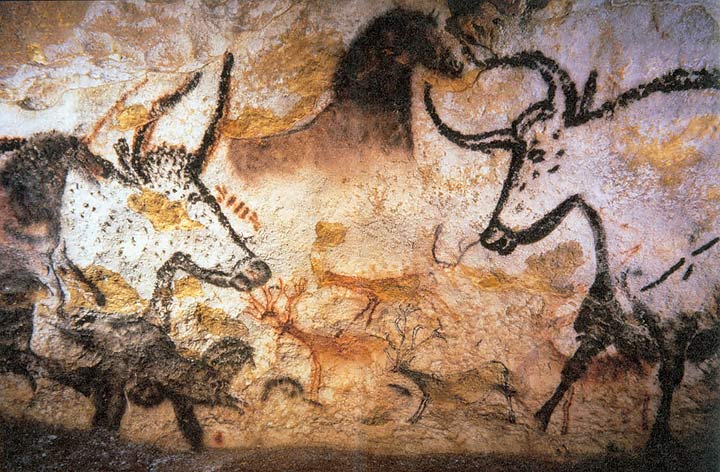
Cave Painting in Lascaux ,France - c. 15,000 B.C.
I've run across representations of cave paintings over the years that included illustrations of white beasts, speckled beasts, and black ones with a white line down their back - which, as discussed in a February blog, has long been known as the Riggit pattern.  What I never realized is those cave paintings are considered to be drawings of the auroch - so I deserve quite a thump on the head for missing that!


Cave Painting in Lascaux, France
You can see in this first photo that the aurochs represented in this French cave painting are white, with darker noses, and actually speckled as well.  And this next one also shows a white speckled auroch, along with a horse and some other type of small animals which are portrayed as brownish in color.  The ears and nose are distinguished as a different color in both drawings, and in the first drawing you can see that the legs are dark - quite like both the horned and polled Park cattle of today.


In 2010 it was reported that an experiment had commenced to attempt to re-create an auroch from breedings amongst those modern day domestic breeds considered to be most representative of the auroch.  In this article from The Telegraph we are told that the Highland of Britain and the ". . . white Maremma breed from Italy," are two of the breeds being used in this experimental "back-breeding".  If you do a web search for images of the Maremma breed, you get results with both white examples and grey examples of this breed, also two different spellings:  Maremma and Maremmana .  Here is a photo of a "white Maremmana" . . . 


Maremmana Cattle
White Maremmana - by Amenon on Flickr

The inclusion of the white Maremma in this experiment certainly indicates that the scientific community considers the Park color pattern to be one of great antiquity that indeed was found in the indigenous aurochs of prehistoric times.  But then, I would think that most every basic, or root, coloration of modern day domestic cattle would track back to ancestral aurochs . . . What I find sad, inexplicable, and irritating is that clearly the milk white auroch of prehistoric times --  as well as the milk white cow of modern recorded history  -- were both highly revered back in days long long gone . . . NOW, they are generally found undesirable here in the USA by the commercial cattle industry . . .  thanks in large part to the promotional success of Certified Angus Beef  and the dominating USA demand for black hided cattle.

The future of British White Cattle continues to be in the hands of largely hobby farmers in the USA.  Their owners are captivated by their beauty and uniquely gentle natures, and of course the quality of the beef.  If you would like to help promote greater awareness and acceptance of polled British White Cattle in the mainstream cattle industry  - visit  the United Kingdom's British White Cattle Society web site for additional information.
Lascaux Cave Painting, France